

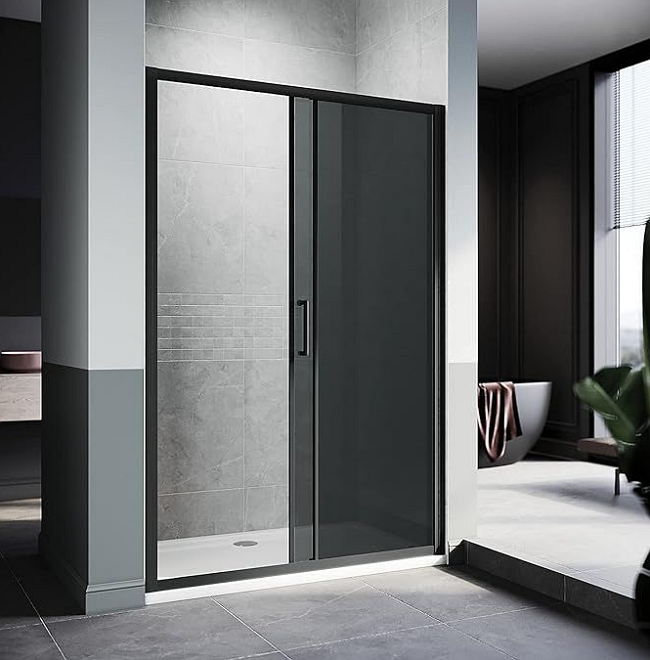
When you’re planning a small bathroom renovation, one question almost always comes up: “Will a bold, dark feature like a black shower screen make my compact space feel even smaller?” It’s a fair concern. After all, conventional wisdom says light colours expand a room while dark colours shrink it. But what if that rule wasn’t absolute?
Here’s the truth: a black shower screen for small bathrooms can actually be a powerful tool for maximising space—if you choose the right design. The secret lies not in avoiding black, but in using it intentionally. A slim black frame around clear glass creates definition, draws the eye, and makes a small bathroom feel deliberate and designed rather than cramped.
In this guide, we’ll explore 5 smart ideas to maximise space with black shower screens, directly addressing the worry that a dark feature will make your room feel smaller. You’ll learn how to combine clear glass for light flow, which space-saving options (sliding, pivot, and fixed short screens) work best in tight layouts, and why the illusion of space often starts with a single black line.
How a Black Line Defines Your Small Bathroom
One of the most surprising discoveries in modern bathroom design is that a black shower screen doesn’t necessarily make a small room feel smaller. Instead, the black frame acts as an architectural line that defines the space. Think of it like a picture frame: a dark border around a light image actually draws your eye inward and creates a sense of structure.
In a small bathroom, where multiple fixtures compete for attention, a strong visual boundary can reduce clutter and make the shower area read as an intentional zone. This illusion of space works because the human eye appreciates clear delineation. When a shower screen blends into the walls, the room can feel chaotic. But a bold black line says, “This is the shower. Everything else is separate.” The result? A small bathroom feels more organised, more spacious, and more photogenic—many interior photographers use black-framed screens precisely because they make rooms look larger in images.
Creating a Focal Point to Maximise Sense of Space
Another psychological trick: a black shower screen can serve as a room’s focal point. In a tiny ensuite or cloakroom bathroom, having one strong feature stops the eye from bouncing frantically between a toilet, a sink, and a shower. That pause creates a sense of calm and intentionality—which feels like space. When a room has a clear hero element, the rest of the layout fades into a supportive role, and the overall impression is one of thoughtful design, not cramped compromise.
Complementing Light to Counteract the Dark Feature
Of course, a black shower screen isn’t a magic wand. Its success relies entirely on what you pair with it. To prevent a small bathroom from feeling like a cave, you must combine the black frame with clear glass (more on that shortly) and surround it with light-reflective surfaces: glossy white tiles, large mirrors, bright vanity units, and layered lighting. The contrast between a deep black frame and brilliant white or pale grey surfaces actually makes the light areas feel brighter and more expansive.
5 Smart Ideas to Maximise Space with Black Shower Screens
Smart Idea 1: The Clarity of Clear Glass to Maximise Light Flow
If you take only one lesson from this article, let it be this: always combine your black shower screen with clear glass. A solid black wall would absolutely shrink a small bathroom. But a black frame holding a panel of clear glass does the opposite. The transparent surface allows both natural and artificial light to travel unimpeded across the room. Sightlines remain open from the vanity to the shower to the window.
This is the single most effective way to maximise space visually. Clear glass preserves the visual volume of the room, while the black frame adds just enough structure to feel intentional. Without clear glass, a small bathroom with a black screen would feel closed off. With it, the room breathes. In fact, many UK interior designers now recommend clear glass black shower screens for London flats and period conversions where natural light is already at a premium. The transparency keeps the room from feeling like a tunnel, while the dark frame grounds the design.
Pro tip: For bathrooms with privacy concerns (e.g., a ground-floor ensuite), consider tinted clear glass – a barely-there grey or bronze tint that offers minimal visual obstruction but reduces see-through visibility. Avoid heavy frosted glass, as it scatters light and reduces that essential light flow.
Why Clear Glass is a Superior Space-Saving Solution
Compare clear glass to the alternatives. A shower curtain, even in a light colour, creates a physical and visual barrier. It cuts the room in half, making the shower feel like a small tent and the rest of the bathroom like a narrow hallway. Opaque or frosted glass panels, while offering privacy, also block light and reduce the sense of openness. Clear glass with a black frame is superior because it maximises both light flow and visual continuity – two non-negotiable elements for any small bathroom layout.
Real-world example: In a 2m x 1.8m ensuite (typical for a UK terrace house conversion), switching from a white shower curtain to a black-framed clear glass sliding screen made the room feel almost twice as large, according to a case study from a Bristol bathroom renovator. The clear glass allowed the patterned floor tiles to be seen across the entire space, creating an uninterrupted visual plane – a classic illusion of space trick.
Smart Idea 2: Frameless or Minimal Frame for Seamless Design
Frameless Black Shower Screens: Maximising a Minimalist Aesthetic
Not all black shower screens are created equal. For the ultimate in space-maximising design, consider a frameless black shower screen. In this configuration, the glass itself has no bulky frame; instead, minimal black hardware – hinges, brackets, and a slim handle – provides the dark accent. The result is a nearly invisible barrier that still delivers that bold black contrast.
This style is perfect for ultra-compact bathrooms where every millimetre of visual weight matters. The glass seems to float, and the black elements become delicate lines rather than heavy borders. It’s a minimalist’s dream and a practical solution for maximising space without sacrificing style.
Installation consideration: Frameless screens require perfectly level walls and floors because there’s no bulky frame to hide imperfections. Budget for professional installation if your bathroom is older or has uneven tiling.
Black Trim, Minimalist Impact for a Smart Layout
Another popular option in the UK is the “Crittall” style – a black-framed screen with multiple small glass panes divided by slim black bars. While this has more visual activity than a single frameless panel, the thinness of the bars keeps it from feeling heavy. This style works beautifully in small bathrooms that lean toward industrial or vintage-modern aesthetics. The key is to keep the frame profile as slim as possible; chunky frames are the enemy of space-saving design.
Smart Idea 3: Space-Saving Sliding Shower Screens for Tight Layouts
Sliding Shower Screen Black Frame – The Ultimate Swing-Free Solution
When floor space is at a premium, the worst enemy is a door that swings open. A traditional hinged shower screen can require 60–70 cm of clearance in front of it – clearance that many small bathrooms simply don’t have, especially if the toilet or vanity sits nearby. Enter the sliding shower screen black frame.
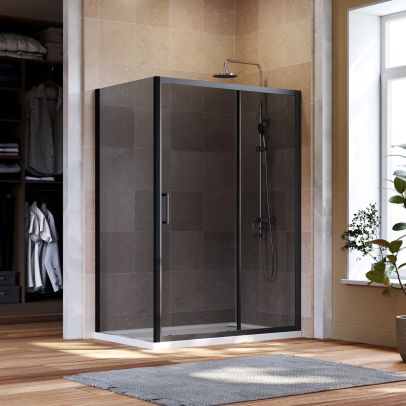
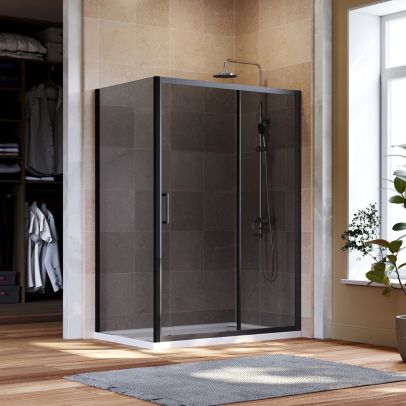
A sliding shower screen glides along a top and bottom track, requiring no swing clearance at all. The doors stack neatly to one side (or both sides, in a bypass configuration), preserving every centimetre of floor space. This is arguably the most practical space-saving option for narrow ensuites, cloakroom bathrooms, or any layout where a swinging door would hit another fixture.
How much space do you save? A typical 700mm-wide hinged door needs 700mm of clear floor space in front of it. A sliding door needs exactly zero. That’s enough room to fit a small vanity unit or a compact WC. In a bathroom that’s only 1.5m wide, that swing clearance can make or break the layout.
Maximise Floor Clearance with a Sliding Black Shower Enclosure
Beyond preserving swing space, a sliding black shower enclosure also keeps the bathroom feeling open because the door never protrudes into the room. You can stand at the sink, open the shower door, and still have full access to the toilet – all without shuffling around an obstructive panel. For families or shared bathrooms, this is a game-changer.
Maintenance note: Sliding screens have bottom tracks that can collect soap scum and hair. Look for models with a lift-off door design (the doors can be lifted out for thorough cleaning) or a low-profile track with a self-draining channel.
Product Spotlight: A Black Sliding Screen for a Compact UK Bathroom
Here are three excellent space-saving options available in the UK (expanded from original):
-
Modern Bathroom Black Framed 1400x1850mm Sliding Shower Door (B&Q): A solid all-rounder with durable 6mm safety glass, an adjustable design for out-of-square walls, and a contemporary matt black aluminium frame. Ideal for standard alcove installations. Price ~£350.
-
ELEGANT 1400 x 700 mm Sliding Shower Enclosure (Elegant Showers UK): A complete cubicle solution in a sleek black finish, coming with a tray and waste. Perfect for those seeking a full enclosure without separate purchases. Price ~£280.
-
Aqualux AQ7 Sliding Door in Matt Black (Victorian Plumbing): Features 6mm toughened safety glass, a magnetic door seal for splash protection, and a 10-year guarantee. Sizes from 800mm to 1400mm. Price ~£400.
Smart Idea 4: Pivot Shower Screens – Flexible Access for Small Entry Points
A pivot shower screen operates on a central hinge, allowing the door to swing both inward and outward. This flexibility is a lifesaver in small bathrooms where the entrance to the shower is unusually narrow or where the bathroom door itself opens toward the shower. With a pivot mechanism, you can angle the screen to create just enough passage space without fully opening into the room.
When to choose pivot over sliding: Pivot screens are generally less expensive than sliding screens (because they have fewer moving parts) and take up less wall space. They’re ideal for corner showers or for bath-tub showers where a sliding track would interfere with the tub’s rim. However, they still require some swing clearance – just less than a hinged door – so measure carefully.
Slim Pivot Bath Screen for Tight Entrances and Awkward Spaces
What makes a pivot bath screen particularly useful is its 180-degree folding range. You can push it completely flat against the wall or rotate it to any angle that suits your movement. For awkward L-shaped layouts or bathrooms with sloping ceilings (common in UK conversions, especially loft bathrooms), a pivot screen adapts where fixed or sliding screens cannot.
Installation tip: Ensure your pivot screen has a dual-direction stop that prevents the glass from swinging too far and hitting a wall or fixture. Some budget models only pivot one way – a nightmare in a tight layout.
Smart Idea 5: Fixed Short Screens for an Open, Minimalist Look
If you want the most open, airy feel possible, consider a fixed short screen. These panels are typically half-height (around 100–120 cm tall) and fixed permanently in place – they don’t move. Their purpose is not to enclose the shower completely but to block the most active splash zone while leaving the upper half of the shower completely open to the rest of the room.
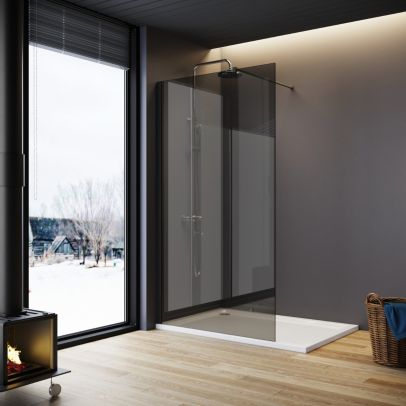
A fixed short black screen is the ultimate space-saving option for wet rooms or walk-in showers. Because there’s no door mechanism, no track, and no moving parts, the visual interruption is minimal. The black frame provides that defining line, but the open top allows light and sightlines to flow uninterrupted. In a small bathroom, this can create a spa-like, hotel-bathroom feel without the claustrophobia of a full enclosure.
Best use case: A fixed short screen works brilliantly when your shower area is at the far end of a small bathroom, away from the main traffic path. It’s also perfect for disabled access or aging-in-place designs because there’s no threshold or door to negotiate.
When a Fixed Shower Screen is a Smart Space-Saving Choice
This design works best when your bathroom has good drainage and you’re willing to accept some water mist on the surrounding floor (easily managed with a towel or a well-placed bath mat). For those who prioritise a seamless, spa-like aesthetic over total water containment, a fixed short black screen is hard to beat. It’s also the easiest to clean, with no tracks or hinges to trap grime.
Real-world warning: In a very small bathroom with poor ventilation, the open top of a fixed short screen can let steam escape into the whole room, potentially causing condensation on mirrors and windows. Ensure you have an efficient extractor fan (minimum 15 litres per second, as per UK building regulations) if you choose this route.
Choosing the Right Black Shower Screen for Your Small Bathroom
Selecting the right black shower screen for small bathrooms goes beyond aesthetics—it requires matching the screen's mechanics to your specific layout, space constraints, usage needs, and maintenance tolerance. The table below provides a quick overview, but the detailed breakdown that follows will help you navigate the nuances of each option.
| Screen Type | Best For | Space-Saving Feature | Swing Clearance Needed | Typical Price (UK) |
|---|---|---|---|---|
| Sliding | Narrow ensuites, toilets near shower | Zero swing clearance | None | £280–£450 |
| Pivot | Awkward corners, bath-tub showers | 180° fold flat | ~30cm | £120–£450 |
| Fixed Short | Wet rooms, walk-in showers, accessible design | No moving parts, open top | None | £220–£300 |
| Frameless Minimal | Ultra-modern, high-end small bathrooms | Nearly invisible hardware | Depends on hinge type | £400–£800 |
Practical Tips for Maximising Your Black Shower Screen’s Impact
Bathroom Layouts with a Black Shower Screen
-
Corner Installations: Place your black shower screen in a corner to turn an awkward area into a design feature. Corner showers are classic space-maximisers, and a black frame adds definition.
-
Walk-in Shower Layouts: In a walk-in wet room, a single black-framed glass panel can act as a chic water deflector without enclosing the space. This is one of the most popular space saving trends in UK bathroom design.
Complementary Design Choices
-
Tiles: Choose large-format, light-coloured tiles (glossy white, pale grey, or cream) to minimise grout lines that create visual clutter. Large tiles also reflect more light.
-
Lighting: Use layered lighting—overhead, wall sconces, and mirror lights—to eliminate shadows. Shadows are the enemy of small spaces; bright, even light expands them.
Maintenance & Durability
-
Easy-Clean Technology: Look for a black shower screen with an “easy-clean” or “hydrophobic” coating. This repels water and reduces limescale build-up, making upkeep simple.
-
Finish Longevity: High-quality black finishes (powder-coated aluminium or anodised black) are corrosion-resistant and durable. Avoid cheap painted finishes that may flake over time.
Frequently Asked Questions About Black Shower Screens for Small Bathrooms
Will a black shower screen make my small bathroom look smaller?
No, not if designed correctly. The black line can help define the space, making it feel more structured and intentional. The key is to combine it with clear glass, which allows light to flow through, and reflective surfaces to keep the room bright.
What is the best black shower screen for a very small bathroom?
A sliding shower screen or a fixed short screen are often the best space-saving options. Sliding doors require no swing clearance, maximising floor space, while a fixed short screen maintains open sightlines for an airier feel.
What colour tiles go best with a black shower screen in a small bathroom?
Light, reflective colours work best. Glossy white tiles, pale greys, creams, or large-format marble-look tiles bounce light around the room, balancing the dark frame and keeping the space bright and open.
Is a black shower screen harder to keep clean?
A black frame is excellent at hiding water stains and limescale compared to white or chrome. However, a glossy black screen can show water spots. A matte black finish is the best compromise, as it resists smudges and fingerprints while remaining modern.
Can I use a black shower screen in an ensuite without a window?
Yes, absolutely. Without natural light, it’s critical to use clear glass and excellent layered lighting (overhead, vanity, and ambient lights). The combination of clear glass and bright artificial light will prevent the room from feeling dark.
Conclusion
A black shower screen for small bathrooms does not have to make your space feel smaller. In fact, when chosen wisely and paired with clear glass, smart space-saving mechanisms (sliding, pivot, bifold, or fixed short screens), and light-reflective surroundings, it does the opposite. The black frame defines the space and creates an illusion of space through intentional design—making your small bathroom feel structured, intentional, and surprisingly spacious.
Your next step? Measure your bathroom carefully. Assess where a swinging door would cause problems. Consider a sliding shower screen for narrow layouts, a pivot screen for awkward entrances, a bifold screen for extremely tight cloakroom bathrooms, or a fixed short screen for an open, minimalist wet room feel. Then commit to a bold black frame with confidence.
For even more inspiration, practical advice, and a wide selection of high-quality black shower screens, black framed enclosures, and walk-in wet room screens, visit Elegant Showers at https://www.elegantshowers.co.uk/. Whether you are searching for a modern shower enclosure with a striking black frame, a space-saving sliding cubicle, or a frameless wet room screen designed specifically for compact UK bathrooms, Elegant Showers offers a comprehensive range of sizes, styles, and configurations to suit every layout.


Validate your login