

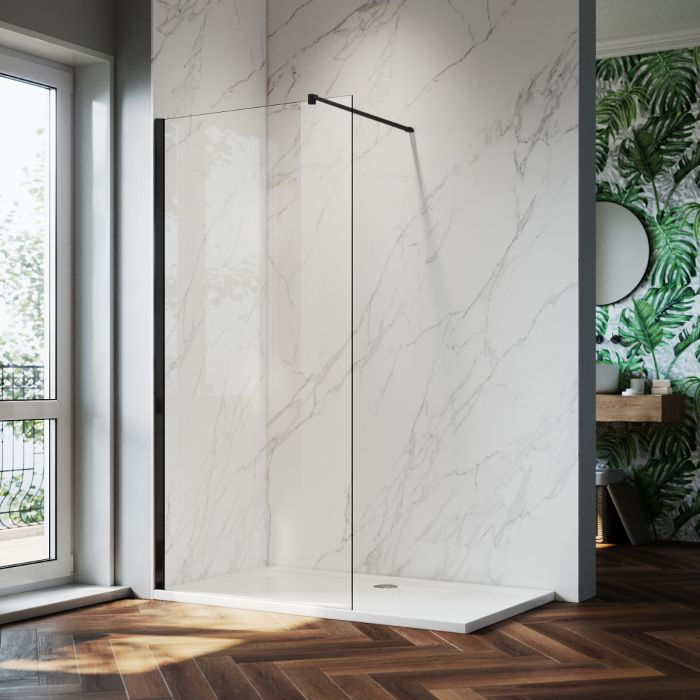
If you have ever stepped out of a walk‑in shower onto a wet bathroom floor, you already understand the central challenge of a wet room. In the UK, where open‑plan, level‑access bathrooms are increasingly popular, one question dominates homeowner searches: how does a flipper panel work with a wet room to prevent water escaping from a tiled floor?
The answer lies in a simple but highly effective glass component: the shower screen with flipper panel. Unlike a traditional shower door or a fixed glass panel, a walk‑in shower screen with flipper panel uses a hinged return that actively blocks water from crossing the floor gradient. This article explains the mechanics, the synergy with tanked tiled floors, and UK installation best practices – helping you understand why a flipper panel shower screen is the smartest defence against water escaping from a wet room floor.
What is Wet Room– Why Water Escapes from a Tiled Floor
A wet room is a level‑access bathroom where the shower area sits flush with the rest of the floor, with no upstand or tray. This design is governed in the UK by BS 5385‑4:2015, which requires a floor fall (gradient) between 1:80 and 1:35 to guide water toward a linear or centre drain. However, even a perfectly tiled floor can fail to contain water.
Water Escaping from Wet Room Floors: The Physics
Three factors cause water to escape:
-
Flow rate vs. deflection – A typical UK power shower delivers 12–15 litres per minute. The water jet hits the body and splashes forward, often beyond the intended shower zone.
-
Floor gradient limits – A 1:60 fall means water travels only 60mm for every 1mm of height drop. Splash that lands 300mm from the drain may not have enough slope to return.
-
Grout is not waterproof – Tiles and grout are water‑resistant, but not impervious. The NHBC 2025 Standards (Technical Guidance 9.2/06) mandate a full tanking system – a liquid membrane or sheet membrane – behind tiles. Without a flipper panel, water can still escape over the tile surface before it ever reaches the drain.
The "Tanked" Floor vs. The Tiled Surface
Tanking stops moisture migrating into the subfloor, but it does nothing to stop surface water running into the dry area. That is why a shower screen with flipper panel is essential: it acts as a mechanical barrier, catching splash and runoff while the floor grading does the rest.
What is a Flipper Panel for Shower Screens?
A walk in shower screen with flipper panel is a short, hinged glass return panel attached to a fixed glass screen. It is typically 300mm wide and made from 8mm toughened safety glass (BS EN 12150 certified).
The 180° Hinge Mechanism
-
Folded in (showering) – The panel rotates inward to 90°, blocking water from escaping the front edge of the shower zone. It also traps warm air, reducing draughts – a welcome benefit in British bathrooms.
-
Folded flat (exit) – After showering, the panel rotates a full 180° to lie flat against the fixed screen. This creates a completely barrier‑free entry/exit, essential for level‑access wet rooms and compliance with Approved Document M of the Building Regulations.
Materials and Standards
UK‑compliant flipper panels use solid brass hinges (corrosion‑resistant for wet environments) and magnetic seals to keep the panel stable when folded in. The glass must be toughened, not annealed, to meet safety standards.
How to Use and Operate a Flipper Panel in a Wet Room
A shower screen with flipper panel is only effective if used correctly. Many UK homeowners assume that simply having the panel installed is enough to stop water escaping from a wet room floor. In reality, small daily habits – like which way you fold the panel and when you open it – determine whether your tiled-floor wet room stays dry or becomes a slipping hazard.
Below is a detailed, step‑by‑step operational guide for anyone using a walk in shower screen with flipper panel.
Step 1: Pre‑Shower – Fold the Flipper Inward
Before you turn on the water, you must rotate the flipper panel inward (toward the shower head) until it clicks into the magnetic seal. The panel should sit at approximately 90 degrees to the fixed glass screen.
-
Why this matters: When the flipper is folded inward, it catches the forward momentum of water spraying off your body. Without this position, water travels straight off the edge of the fixed screen and onto the dry bathroom floor – completely bypassing the floor gradient and tanking system.
-
Common mistake: Some users leave the flipper folded flat against the wall, thinking it looks tidier. This turns your walk in shower screen with flipper panel into a useless fixed panel, and water will escape immediately.
Step 2: During the Shower – Let the Panel Work
Once the flipper is correctly positioned, the physics of water containment takes over. Water hits the glass, runs down vertically, and falls onto the tiled floor within the graded shower zone. From there, the floor fall (1:80 to 1:35) guides water toward the drain.
-
Optimal shower head angle: Aim the spray slightly downward or away from the flipper gap. If your shower head is adjustable, keep the jet at least 300mm away from the flipper edge.
-
Monitoring the seal: Occasionally check the bottom of the flipper where it meets the tile. A small amount of weeping (a few drops) is normal, but a steady trickle means the silicone seal or hinge tension needs adjustment.
Step 3: Exiting the Shower – Fold the Flipper Flat
After you turn off the water, do not step out immediately. First, push the flipper panel fully open – 180 degrees – so it lies flat against the fixed screen. Then exit.
-
Why this is critical: If you leave the flipper folded inward, three problems occur:
-
Water trapped on the inner face of the panel drips onto the floor outside the shower zone.
-
The magnetic seal stays compressed, reducing its lifespan.
-
Air cannot circulate, leading to mould growth on the hinge and floor grout.
-
-
Barrier‑free access: With the panel flat, you have a completely open walkway. This is especially important for wheelchair users or those with mobility aids, and it directly supports compliance with Approved Document M of the Building Regulations.
Step 4: Post‑Shower Drying Routine
Within five minutes of showering, use a squeegee to wipe down both sides of the flipper panel and the fixed screen. Pay extra attention to the bottom edge of the flipper, where water pools.
-
Floor drying tip: Because the flipper is now flat, you can run a dry mop or towel across the entire wet room floor without obstruction. This prevents limescale buildup on the tiles and reduces slip risk.
-
Hinge care: Once a week, after drying, open and close the flipper panel fully two or three times. This distributes any residual moisture away from the brass hinge pin, preventing stiffness over time.
What Not to Do (Common UK User Errors)
| Mistake | Consequence |
|---|---|
| Using the flipper as a towel rail | Excess weight can misalign the hinge, causing the panel to sag and break the magnetic seal. |
| Slamming the flipper shut | Can crack the toughened glass at the hinge fixing point (not covered by warranty). |
| Leaving the flipper inward overnight | Trapped moisture encourages black mould on silicone seals and grout lines. |
| Ignoring a loose hinge | A flipper that drops 2–3mm will no longer seal against the fixed screen, rendering it useless for water deflection. |
Summary of Correct Operation
To keep your walk in shower screen with flipper panel working effectively on a tiled-floor wet room, remember this simple routine: Fold in before water, fold flat after drying. Follow that rule, and you will drastically reduce the risk of water escaping from your wet room floor.
Alternatives to a Flipper Panel – A Detailed UK Comparison
While a walk in shower screen with flipper panel is widely considered the best solution for water containment on a tiled wet room floor, it is not the only option. Homeowners and installers sometimes choose alternatives due to budget, aesthetics, or space constraints. However, each alternative comes with significant trade-offs, especially when it comes to preventing water escaping from a wet room floor.
Below is an honest, practical comparison of the main alternatives available in the UK market, based on real-world performance on tanked, tiled floors.
Alternative 1: Fixed Glass Panel (No Flipper)
A single fixed glass screen attached to the wall, with no moving parts. The entry is completely open.
| Pros | Cons for Tiled Wet Room Floor |
|---|---|
| Minimalist, frameless aesthetic | No water deflection – Water runs straight off the front edge of the panel and across the bathroom floor. |
| Cheapest option (£150–£300) | Only works if the shower head is positioned at the far end of a very long (1.2m+) panel – impractical for standard UK bathrooms. |
| No hinges to maintain | Does not comply with best practice for wet rooms (NHBC guidance recommends a return panel). |
Verdict: Only suitable for very large wet rooms (over 2.5m long) where the shower is at one end and the dry area is far away. For 90% of UK homes, a fixed panel alone will lead to water escaping from the wet room floor.
Alternative 2: Bi‑Fold Shower Door
A door made of two or three narrow glass panels hinged together, folding like an accordion. Often used over a shower tray.
| Pros | Cons for Tiled Wet Room Floor |
|---|---|
| Folds completely out of the way, saving space. | Multiple hinge gaps – Each fold creates a vertical gap where water can spray through, especially under high UK water pressure. |
| Can be retrofitted to existing fixings. | No bottom seal works perfectly on a tiled floor (unlike a tray with a lip). Water escapes under the bottom edge. |
| Lower cost than a premium flipper panel (£200–£400). | Difficult to keep clean – limescale builds up in every fold. |
Verdict: Bi‑fold doors are acceptable over a raised shower tray, but they perform poorly on a level‑access tiled floor. The combination of hinge gaps and no upstand almost guarantees water escaping from a wet room floor.
Alternative 3: Quarter‑Round / Curved Fixed Panel
A fixed curved glass panel (often semi‑circular or quarter‑circle) that wraps around the shower area.
| Pros | Cons for Tiled Wet Room Floor |
|---|---|
| Very attractive, high‑end aesthetic. | Extremely expensive – bespoke curved glass costs £800–£1,500, often double the price of a flipper system. |
| No moving parts to fail. | Entry is through a narrow gap; the panel cannot fold flat, so it obstructs cleaning and mobility access. |
| Provides some water deflection due to the wrap-around shape. | Still requires a separate return or door to seal the entry gap – most curved panels are sold as part of a full enclosure. |
Verdict: Impractical for most UK wet rooms. The cost is prohibitive, and the lack of a folding return makes it difficult to achieve true level‑access.
Alternative 4: Sliding Door (Bypass or Pocket Door)
Two glass panels that slide horizontally, one behind the other. Common in larger bathrooms.
| Pros | Cons for Tiled Wet Room Floor |
|---|---|
| No swinging door – saves floor space. | Bottom track required – the track is usually 10–15mm high, creating a trip hazard and a dirt trap. |
| Can be used with a low-profile tray. | Sliding tracks are difficult to seal against a tiled floor; water inevitably pools in the track and leaks out. |
| Good for wide openings (1.2m+). | Cannot fold flat – access width is reduced by half. Not compliant with Part M for disabled access. |
Verdict: Better suited to shower trays than tiled wet room floors. The bottom track is incompatible with the seamless, level‑access design of a true wet room.
Alternative 5: No Screen at All (Open Wet Room)
Some modern designs use no glass – just a floor gradient and a linear drain.
| Pros | Cons for Tiled Wet Room Floor |
|---|---|
| Maximum accessibility – no barriers at all. | Very high risk of water escaping unless the room is huge (over 4m²) and the shower head is low‑flow (under 8 L/min). |
| Minimalist, hotel‑style look. | Splash and overspray will soak towels, toilet paper, and any wooden furniture within 1.5m. |
| Easy cleaning. | Not recommended by any UK wet room manufacturer or NHBC for residential use. |
Verdict: Only suitable for very large, dedicated wet rooms with a central drain and no nearby fixtures. For a typical UK bathroom (2m x 2m), going screen‑free will lead to persistent damp and potential subfloor damage.
Why the Flipper Panel Remains the Best Choice for Tiled Floors
After comparing all alternatives, the shower screen with flipper panel uniquely offers:
-
Active water deflection – The 300mm inward fold catches splash before it escapes.
-
Level‑access compliance – Folds completely flat for wheelchair use (Part M).
-
No bottom track – Seals directly against the tiled floor with silicone, preserving the seamless wet room look.
-
Cost‑effective – Typically £350–£700, far less than curved glass or complex sliding systems.
For any UK wet room where the shower head is within 1.2m of the dry area, a walk in shower screen with flipper panel is not just an alternative – it is the correct technical solution.
Frequently Asked Questions (FAQ)
Do I need a flipper panel in a wet room?
Yes, for any open‑plan wet room with a tiled floor. Without a physical upstand, a shower screen with flipper panel is the most effective way to stop water escaping from a wet room floor. The 300mm flipper catches forward splash and returns it to the graded shower area where the tanking system and floor fall can guide it to the drain. A fixed panel alone will not prevent water from travelling across the dry bathroom floor.
How do you clean a flipper panel?
Use a squeegee after every shower. For limescale, apply a 50/50 white vinegar and water solution. Avoid bleach or abrasive cleaners – they damage the easy‑clean coating.
What is the standard width of a flipper panel?
300mm is the standard. This width balances water deflection and unobstructed entry. Some compact models use 215mm, but they are less effective against splash.
Can I fit a flipper panel to an existing wet room screen?
Yes. Many manufacturers sell retrofit hinge kits that clamp onto the edge of an existing 8mm glass panel. This is a cost‑effective upgrade.
What glass thickness should I choose – 8mm or 10mm?
Both are acceptable, but 8mm is the most common and cost‑effective standard for wet rooms. It is specified in the majority of UK products (e.g., B8, Elegant, Acezanble, Scudo). 10mm glass offers extra strength and feels more substantial, making it less likely to vibrate in high‑traffic bathrooms; it is also easier to keep smear‑free. However, 10mm panels are typically £100–£200 more expensive and require compatible heavy‑duty hinges and support bars. For most domestic installations, 8mm toughened safety glass (BS EN 12150 certified) is perfectly adequate.
Conclusion
A walk in shower screen with flipper panel is not a luxury—it is a functional necessity for any UK wet room with a tiled floor. By actively deflecting water back into the graded shower zone, it solves the age‑old problem of water escaping from a wet room floor. For the best results, always pair your flipper panel with a certified tanking system, a floor fall compliant with BS 5385‑4, and 8mm toughened safety glass.
If you are designing or renovating a level‑access bathroom, choose a reversible shower screen with flipper panel that matches your layout. Invest in solid brass hinges and an easy‑clean coating. And never skip the floor support bracket. Do all of that, and your wet room will remain dry, safe, and compliant for years to come.
Ready to transform your bathroom with a high‑quality flipper panel? Elegant Showers UK offers an extensive range of stylish and durable walk in shower screens with flipper panels designed specifically for UK wet rooms and tiled floors. Elegant shower screnn with flipper features 6mm and 8mm toughened safety glass, 300mm flipper/return panels with 180‑degree rotation, easy‑clean nano glass technology for effortless maintenance, and universal left or right fitting for complete flexibility.
Whether you are looking for a shower screen with flipper to retrofit an existing enclosure, or a complete wet room solution—including compatible low‑profile stone resin trays and all necessary fixings—Elegant Showers has you covered. Their products come with a waterproof guarantee, rust‑resistant stainless steel fittings, and free delivery to most UK mainland postcodes.
Visit www.elegantshowers.co.uk today to browse their full range of flipper panel solutions and find the perfect fit for your wet room.





Validate your login