

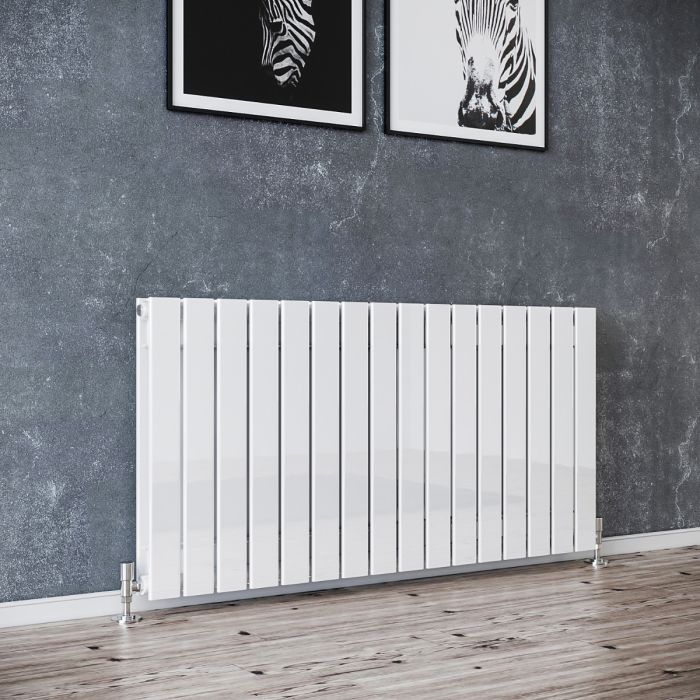
Choosing the right radiator for your room isn't just about aesthetics—it's about comfort, energy bills, and heating efficiency. Ask most homeowners in the UK what size radiator they need, and you’ll often get a shrug. Yet, getting this decision wrong can leave you shivering through winter or paying through the nose for wasted heat. This guide answers the two questions UK homeowners care about most: Is the BTU calculation accurate? and Is the heating sufficient? We'll cover everything from measuring your room to understanding Delta T, so you can finally answer that nagging question: what size radiator do I need?
Table of Contents
- What Is a BTU and Why Does It Matter for Radiator Sizing?
- How to Calculate the BTU Requirement for Your Room
- Radiator Types and How They Affect Sizing
- Common Mistakes to Avoid When Sizing a Radiator
- Frequently Asked Questions (FAQs) About Choosing the Right Radiator Size
- Ready to Find Your Perfect Radiator?
What Is a BTU and Why Does It Matter for Radiator Sizing?
Before you can even begin to answer the question “what size radiator do I need?”, you must first understand the unit of measurement that dictates every radiator purchase in the United Kingdom: the British Thermal Unit (BTU) . In its most basic definition, one BTU is the amount of heat energy required to raise the temperature of one pound of water by one degree Fahrenheit. While that might sound like a relic of imperial measurement, the BTU remains the undisputed industry standard for quantifying radiator heat output across the UK heating sector.
Think of the BTU rating as the "engine size" of your radiator. Just as a larger car engine produces more horsepower, a radiator with a higher BTU output delivers more heat into your living space. When you browse any UK supplier—whether it's Stelrad, BestHeating, or City Plumbing—every product listing will prominently display its BTU output. This figure is the single most critical number you will use to determine whether a radiator is powerful enough to warm your room effectively. Without understanding this metric, you are essentially guessing, and guessing when it comes to central heating usually leads to chilly winters or extortionate energy bills.
BTU vs Watts: Why Both Matter
If you have spent any time looking at radiator specifications, you will have noticed that manufacturers almost always list heat output in both BTUs and Watts. This dual-listing exists because while the UK traditionally uses BTUs for heating calculations, the European standard (and the wider metric world) relies on Watts. The relationship is fixed and simple: 1 Watt equals 3.412 BTUs per hour. Conversely, to convert BTUs to Watts, you divide the BTU figure by 3.412.
For example, a medium-sized double panel radiator might be rated at 5,000 BTU. To find its Watt equivalent, you divide 5,000 by 3.412, which gives you approximately 1,465 Watts—or 1.46 kW. This conversion is particularly useful when you are comparing radiators from European manufacturers or when you need to cross-reference your heat loss calculation with the output of your boiler or heat pump. While Watts are technically more universal, BTU remains the language of choice for most UK consumers and installers. When you search for a "BTU calculator" online, you are engaging with this metric directly, and most heating engineers will instinctively ask for your required BTU before recommending a specific model.
Why BTU is the Absolute Standard for Radiator Selection
The reason BTU has endured as the gold standard for radiator sizing is simple: it provides a universal, apples-to-apples comparison across different radiator types, materials, and brands. Whether you are considering a sleek, modern vertical radiator for a city-centre flat, a traditional cast iron radiator for a period cottage, or a high-output Type 22 double panel convector for a large living room, the BTU output allows you to objectively compare their heating capabilities without being swayed by aesthetics alone.
Critically, matching the BTU output of your chosen radiator to the specific BTU requirement of your room is the only way to guarantee heating sufficiency. If a radiator delivers fewer BTUs than your room demands, the space will never reach your desired temperature on the coldest days of the year. Your boiler will run continuously, trying in vain to compensate, driving up your energy bills while leaving you reaching for extra jumpers. Conversely, if you choose a radiator with a significantly higher BTU output than necessary, you risk overheating the space. However—and this is a crucial distinction for UK homeowners—an oversized radiator can always be tamed with a thermostatic radiator valve (TRV) , whereas an undersized radiator is a permanent, expensive mistake. This is why understanding BTU is not just technical jargon; it is the foundational knowledge that separates a comfortable, efficient home from a costly, uncomfortable one.
How to Calculate the BTU Requirement for Your Room
Step 1: Measure Your Room Accurately
The first step in working out your BTU requirement is measuring the dimensions of your room—length, width, and height all come into play. Radiator sizes in the UK are measured using the metric system, so measure in metres or millimetres.
Formula: Length (m) × Width (m) × Height (m) = Volume in cubic metres (m³)
Standard UK ceiling height is 2.4 metres. Victorian and period properties often have ceilings of 2.7m to 3.0m or higher—a 3m ceiling adds 25% more air volume compared to a standard 2.4m ceiling.
Step 2: Use a BTU Calculator
The easiest way to get your BTU requirement is to use an online BTU calculator. Most major UK suppliers offer free tools. Simply enter your room details—dimensions, insulation quality, window count, and number of external walls—and the calculator will give you the ideal BTU output you need.
BTU Radiator Calculator
Calculate the approximate radiator output you need for your room. Enter your room dimensions and select the options that best describe your space.
This calculator provides an approximate estimate for guidance only. Actual heat loss can vary depending on insulation, glazing, property construction, room position and heating-system temperatures.
Step 3: Manual Calculation Method
If you prefer to calculate manually, here’s the professional method used by heating engineers across the UK:
BTU = Room Volume (m³) × Heat Rate (W/m³) × Adjustment Factors × 3.412
Base heat rates by room type:
| Room Type | Base Heat Rate (W/m³) | Target Temperature |
|---|---|---|
| Bathroom | 45 W/m³ | 22°C |
| Living Room | 40 W/m³ | 21°C |
| Bedroom | 35 W/m³ | 18-21°C |
| Kitchen | 30 W/m³ | 21°C |
| Hallway/Landing | 35 W/m³ | 18-20°C |
Step 4: Apply a Safety Margin
We recommend choosing a radiator size that is within a 10% range of your calculated BTU requirement. If it’s a choice between buying a radiator that is too small versus one that is too big, it’s always best to buy one that is too large and oversize the radiator. You can always turn a bigger radiator down with a TRV, but you can’t make a smaller radiator give out more heat.
Is the Heating Sufficient? Choosing the Right Radiator Output
The Consequences of Undersizing
An undersized radiator is a false economy. It forces your boiler to run constantly, trying to hit the temperature you’ve set on the thermostat but never quite managing it. This relentless cycle burns through fuel, puts unnecessary strain on your system, and still leaves you feeling cold.
Incorrectly undersized radiators mean:
-
Higher energy bills because you turn up your boiler or heat pump to stay warm
-
Colder homes, as radiators cannot deliver the heat needed to properly warm the room
The Consequences of Oversizing
On the flip side, an oversized radiator isn’t much better. It can create a stuffy, uncomfortable environment by blasting out too much heat, causing sharp temperature spikes before shutting off abruptly. You end up in a constant loop of being too hot, then too cold.
However, oversized radiators can actually improve efficiency with condensing boilers by keeping return water temperatures lower. And with a TRV, you can easily control the output.
BTU Requirements by Room Type and Size
Here are typical BTU ranges by room in the UK, assuming typical UK insulation and double glazing:
| Room Type | Typical BTU Range |
|---|---|
| Living Room | 5,000–9,000 BTU |
| Bedroom | 4,000–7,000 BTU |
| Kitchen | 5,000–8,000 BTU |
| Bathroom | 2,000–4,000 BTU |
| Hallway/Landing | 3,000–6,000 BTU |
| Conservatory | 6,000–10,000+ BTU |
For single glazing or poor insulation, add 15–25%. A radiator rated at 3,000 BTUs is suited to a small room. A large, draughty living room could need over 10,000 BTUs.
Radiator Types and How They Affect Sizing
Single Panel vs Double Panel vs Triple Panel
Radiator types are typically classified by panel configuration:
-
Single panel (Type 10/K1) – suitable for smaller spaces
-
Double panel (Type 21/K2) – more heat output, ideal for larger rooms
-
Triple panel – maximum heat output for challenging spaces
Double or triple panel radiators can improve heat output without taking up significantly more wall space.
Radiator Dimensions: Height, Width, and Depth
UK standard heights include 300mm, 450mm, 600mm, 900mm, and 1400mm. Widths range from 400mm up to 2000mm. Depths typically range from 60mm to 170mm. When measuring for a replacement, remember that radiator sizes in the UK are metric.
Vertical vs Horizontal Radiators
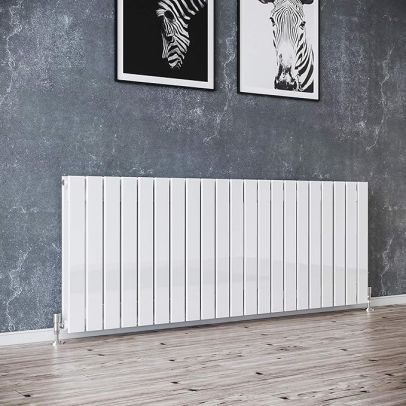
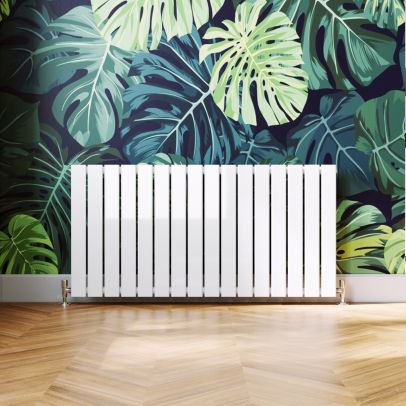
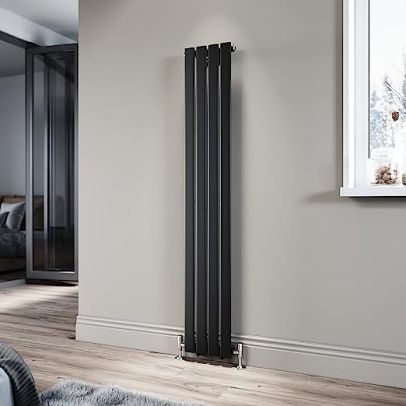
Vertical radiators save wall space but may have different output characteristics. Horizontal radiators are more traditional and often more efficient.
Designer and Column Radiators
Designer radiators and column radiators offer aesthetic appeal but may have different heat outputs. Always check the BTU output, not just the style.
Special Considerations: Heat Pumps and Low-Temperature Systems
Why Heat Pumps Need Different Sizing
Heat pumps operate at lower flow temperatures (35-55°C vs. 60-75°C for gas boilers). The lower the flow temperature, the harder your radiators need to work to keep rooms cosy. Radiators need larger surface areas to deliver enough heat.
Radiator Sizing for Heat Pumps
If you’re moving to a heat pump, you may need to increase radiator capacity significantly. A radiator rated at 1kW at Delta T50 would need to be increased by a factor of 2.4 if the flow temperature drops from 70°C to 45°C.
Replacement radiators may need to be up to 2.5 times larger. Double or triple panel radiators can improve heat output without taking up significantly more wall space. Aluminium radiators heat up faster than steel or cast iron.
The Delta T Challenge for Heat Pumps
A radiator rated at 1,000W at Delta T50 may only deliver 500W at Delta T30. This is why heat pump radiators must be significantly oversized. Always size radiators based on your heat pump’s operating Delta T.
Common Mistakes to Avoid When Sizing a Radiator
Relying Solely on Room Size
Ignoring insulation, windows, and other heat loss factors is a recipe for disaster. A room ’s BTU requirement depends on far more than just its floor area.
Ignoring Delta T Ratings
Buying a radiator based on Delta T50 output when your system runs at Delta T30 is one of the most common and costly mistakes. Always compare radiators at the same Delta T.
Not Adding a Safety Margin
Failing to add 10-15% to calculated BTU requirements can leave you with a radiator that is borderline insufficient.
Choosing Style Over Substance
Picking a radiator purely for aesthetics without checking BTU output is a common error. Designer radiators often have lower heat output for their size.
Forgetting About Multiple Radiators
Larger rooms may need more than one radiator for even heat distribution. The BTU calculation should account for total heat output from all radiators in the room. In larger spaces, it’s often more effective to install two smaller radiators at opposite ends of the room.
FAQs
Q1: How do I calculate the BTU for my room?
Measure the length, width, and height of your room in metres. Multiply these to get the volume in cubic metres. Then use a BTU calculator that accounts for insulation, windows, external walls, and room type. Alternatively, use the manual method: volume × watts per cubic metre (based on insulation level), then convert to BTU.
Q2: What happens if my radiator is too big?
An oversized radiator can overheat the room and waste energy. However, you can fit a thermostatic radiator valve (TRV) to control the output. Oversized radiators can actually improve efficiency with condensing boilers by keeping return water temperatures lower. The general rule is: it is always better to oversize than undersize.
Q3: What happens if my radiator is too small?
An undersized radiator will struggle to heat the room to the desired temperature. You cannot increase its output, so the boiler or heat pump works harder, increasing energy bills. The general rule is: it is always better to oversize than undersize.
Q4: What does Delta T (ΔT) mean and why does it matter?
Delta T is the temperature difference between the water in your radiator and the room temperature. Most radiator outputs are stated at Delta T50 (flow 80°C, return 60°C, room 20°C). If your system runs at lower temperatures, the actual heat output will be lower than the stated figure. Always check the Delta T rating.
Q5: Is it better to oversize a radiator?
Yes. You can always turn down an oversized radiator with a TRV, but you cannot get more heat from an undersized one. Oversizing also improves efficiency with condensing boilers and heat pumps.
Ready to Find Your Perfect Radiator?
Now that you know exactly how to calculate your BTU requirement and understand the factors that influence radiator sizing, it's time to explore the options available. Whether you're looking for a sleek vertical radiator to maximise floor space, a high-output double panel radiator for a large living room, or a stylish designer radiator that doubles as a statement piece, finding the right solution has never been easier.
Visit Elegant Showers today at https://www.elegantshowers.co.uk/ to explore our full range of radiators. Our collection includes everything from traditional column radiators to modern vertical radiators, towel rails, and heated towel racks—all with clear BTU outputs and radiator dimensions to help you make an informed choice. With competitive prices, fast UK delivery, and expert advice just a click away, Elegant Showers is your one-stop destination for all your central heating needs.




Validate your login