

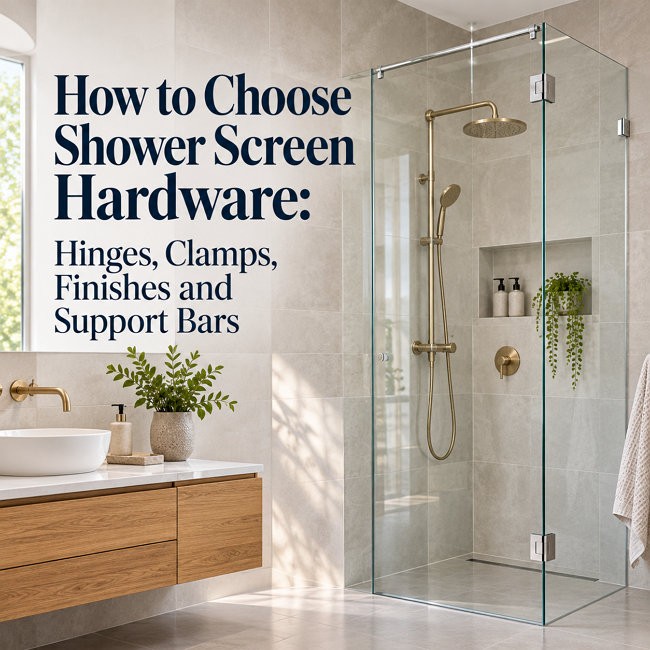
Shower screen hardware used to be the last line of a specification and the first thing an installer improvised on site. That era is over. When CR Laurence (CRL) expanded its Bellagio collection to 16 finishes in October 2026, it confirmed what designers already suspected: hinges, clamps, and support bars are now a design-led category, not a commodity add-on. The same announcement carried a second message, aimed squarely at installers: Bellagio hinges are rated for 8–10 mm tempered glass, 50 kg with two hinges, and a maximum door width of one metre. Aesthetics and structural limits now sit in the same paragraph of the spec.
This guide works through the four decisions that matter most — hinges, clamps, finishes, and support bars — with the glass thickness, load, and UK compliance checks that keep a frameless enclosure safe as well as seamless.
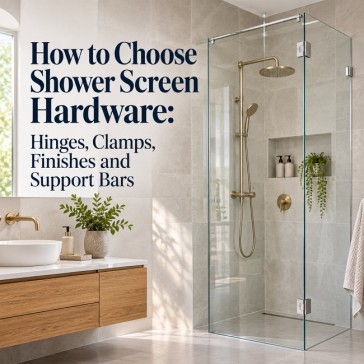
Shower Screen Hinges: Glass-to-Glass vs Glass-to-Wall and Load Ratings
Hinges are the only hardware category that moves, so they carry the most risk. The first choice is where the door hangs from.
What Do Shower Screen Hinges Do?
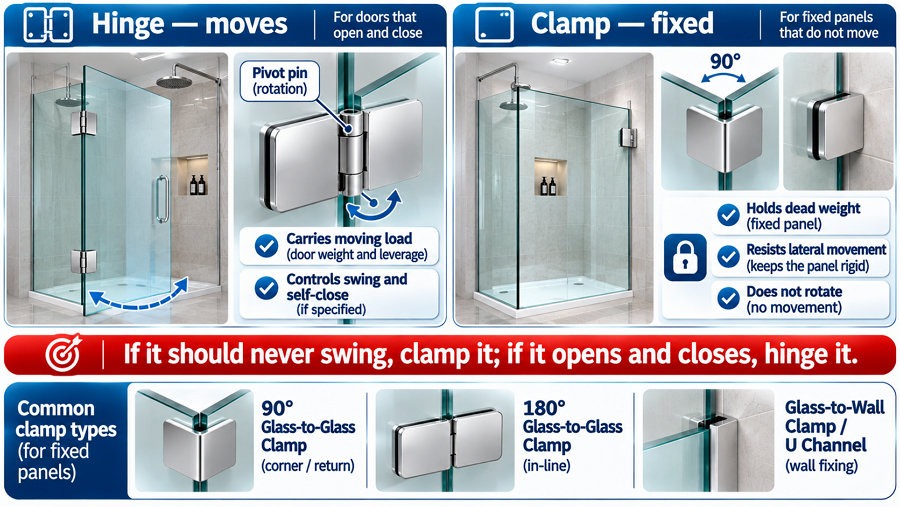
Hinges are the only hardware component that both carries the full weight of a moving glass leaf and controls its motion. In a frameless enclosure, the hinge is the difference between a door that glides shut and one that sags within months. Unlike clamps, which lock a panel in a fixed position, hinges introduce controlled movement—swing, self-closing action, and alignment—while transferring load into the wall or an adjacent glass panel.
Glass-to-Glass Hinges for Frameless Aesthetics
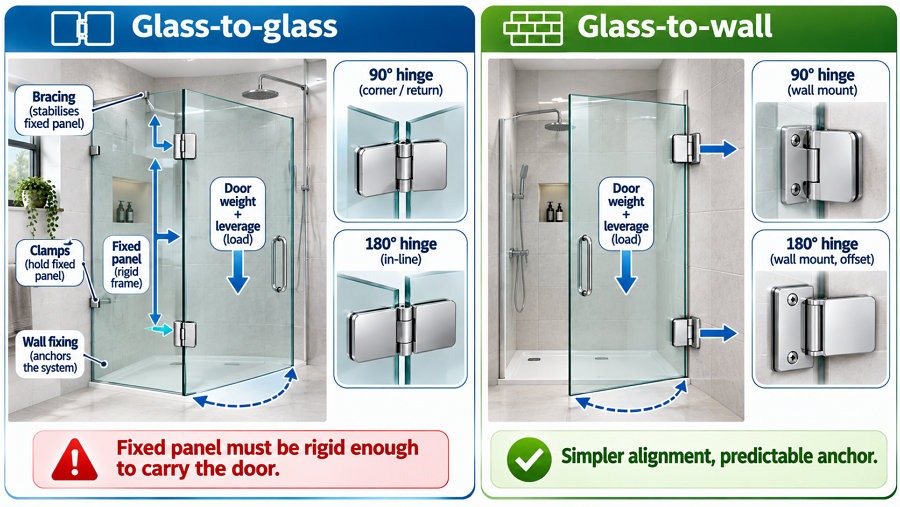
A glass-to-glass hinge connects the door directly to a fixed glass panel, with no visible wall fixing. It is the default for corner enclosures and walk-in screens with a return panel, where the glass edge becomes part of the design language. The trade-off is structural: the fixed panel must be rigid enough to carry the door, which means clamps, bracing, and wall fixings behind it must be specified as a system rather than as separate line items. Bellagio glass-to-glass hinges are available in 90° and 180° versions, both with cover plates and in-built seals.
Glass-to-Wall Hinges for Structural Simplicity
A glass-to-wall hinge fixes the door straight onto masonry or a suitably framed wall. Installers generally prefer it because alignment is simpler and the anchor is more predictable — particularly with heavier 10 mm doors. Designers worry about visible hardware, but modern cover plates solve most of that: Bellagio wall-mount hinges use offset back plates and cover plates to keep the fixing discreet while retaining a positive-close action.
Hinge Load Ratings, Door Width, and Glass Thickness Matching
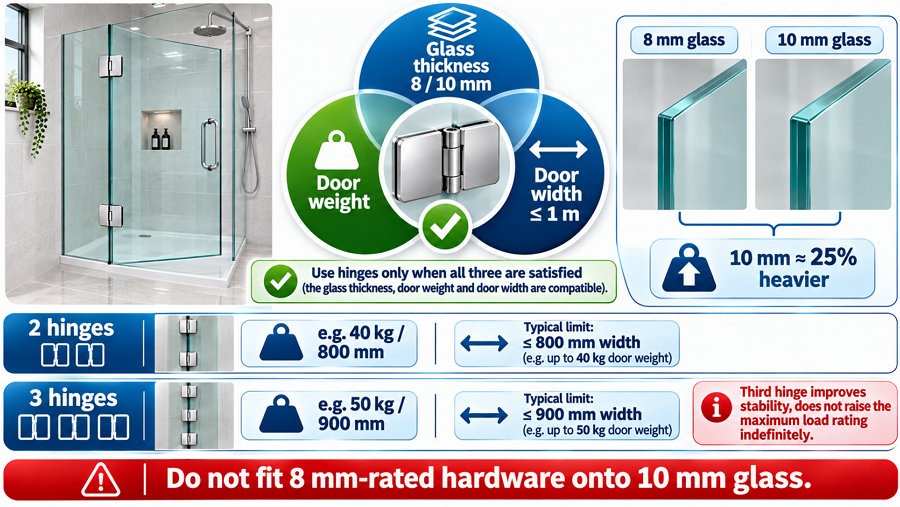
This is where the specification either works or fails. Bellagio hinges are manufactured from solid brass and suit 8 mm and 10 mm tempered safety glass, with a capacity of 50 kg when using two hinges and a maximum door width of one metre. Those three numbers — thickness, weight, width — must all be satisfied together.
Glass weight rises with thickness. A 10 mm panel is roughly a quarter heavier than the same panel in 8 mm, which is why a heavy 10 mm door needs hinges explicitly rated for it. The practical rule for installers is straightforward: two hinges for a standard door, and a third hinge when door width or weight approaches the upper limit. Note, however, that a third hinge does not increase the maximum load capacity — it improves stability and reduces glass stress, so the 50 kg ceiling still applies.
Hinge Weight Capacity and UK Glass Thickness
UK frameless doors typically use 8 mm or 10 mm toughened safety glass, with 10 mm panels weighing roughly a quarter more than the same panel in 8 mm. Hinge capacity must be matched to that weight, not guessed. Representative tested figures for UK-available hardware illustrate the range: two hinges may be rated for 36 kg with a maximum door width of 711 mm, rising to 54 kg with a third hinge and a door width of 813 mm. Other systems list 40 kg with two hinges and 50 kg with three, with door widths up to 900 mm. The practical rule is unambiguous: the hinge must be rated for the glass thickness, door width, and door weight of the specific installation. Self-closing and self-centring hinges add convenience in family bathrooms—one UK hinge specification self-centres within 15 degrees of the closed position—but they should not be chosen at the expense of load rating.
Glass Clamps and Brackets: Fixed Panel Stability and Angle Control
Clamps do not move. That single distinction separates them from hinges, and confusing the two is one of the most common specification errors in frameless work. A hinge lets a door swing; a clamp holds a fixed panel at a set angle.
The Role of Shower Screen Clamps in Frameless and Semi-Frameless Enclosures
Shower screen clamps are fixed brackets that grip the glass and anchor it to a wall or to another glass panel. They do not move like hinges. If a joint should never swing, it should be clamped; if it needs to open and close, it needs a hinge. Clamps carry the dead weight of fixed panels and resist the lateral movement that water pressure, cleaning, and accidental knocks introduce.
90° and 180° Glass-to-Glass Clamps
These hold two fixed glass panels together at a corner or in line. Bellagio glass-to-glass clamps are matched to 8–10 mm tempered glass, mirroring the hinge range so that a single finish and thickness story runs through the whole enclosure. The installer’s check is simple but non-negotiable: match the clamp to the actual measured glass thickness, not the nominal panel size.
Glass-to-Wall Clamps and U Channels
Glass-to-wall clamps and U channels secure a fixed panel to the wall without a hinge. CRL has extended the Bellagio system to include a U Channel, which matters for finish continuity because hidden fixings are still visible at eye level when a client looks closely. Wall substrate is the limiting factor here: lightweight partitions and timber studs may need additional support before tiling, and tile alone is never evidence of structural suitability.
Stabiliser Angle Brackets for Hinged-from-Fixed Configurations
The Stabilizer Angle Bracket is a less familiar component with a very specific job. It is engineered to support hinged-from-fixed side panels with widths of 220–380 mm, suits 8–10 mm toughened glass, and includes wall-angle adjustment for out-of-true walls. For designers, it is available across the Bellagio finish palette, so a small bracket does not become the one mismatched part of the installation. For installers, left- and right-handed versions and solid brass construction make it a practical problem-solver in corner and alcove layouts.
Clamp Compatibility Checklist for UK Buyers
Before ordering any clamp, confirm four things: the glass thickness range (commonly 8–12 mm), the material grade (stainless steel or solid brass for corrosion resistance), whether the glass is pre-drilled or clamp-only, and the load rating of the specific clamp in the specific configuration. Generic “shower screen brackets” listings often omit one or more of these details, and the consequences of a mismatch are structural rather than cosmetic.
Shower Screen Finishes: Polished Chrome, Matt Black, Brushed Brass, Brushed Nickel and Gunmetal
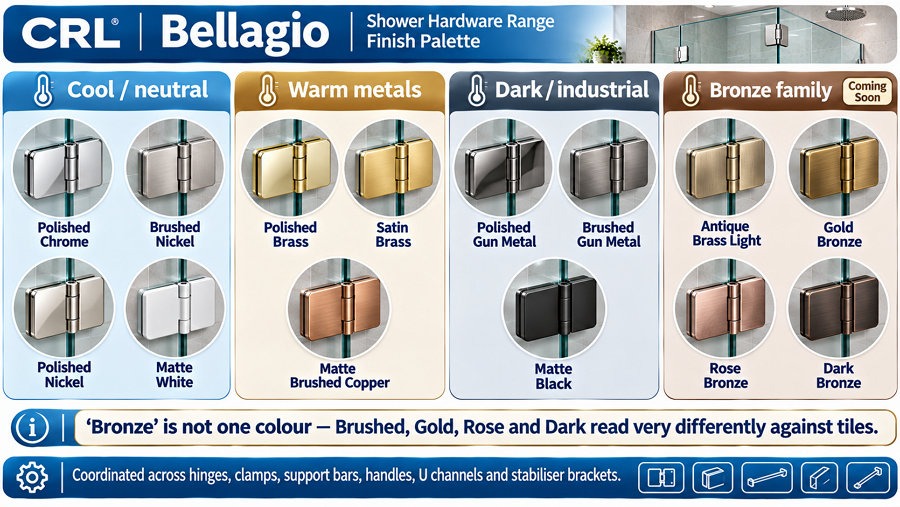
Finish is now the fastest-moving part of the category, and the Bellagio palette shows why. The range spans Polished Chrome, Brushed Nickel, Polished Nickel, Polished Brass, Satin Brass, Matte Brushed Copper, Polished Gun Metal, Brushed Gun Metal, Matte Black, and Matte White, with Antique Brass Light, Gold Bronze, Rose Bronze, and Dark Bronze listed as coming soon.
Why Shower Screen Hardware Finish Matters in UK Bathrooms
In a frameless screen, there is no frame to hide the fixings. Every hinge, clamp, handle, and support bar is on show, which makes the hardware finish a design decision as much as a durability one. Finish also affects how the hardware ages in a UK bathroom: hard water, limescale, and frequent cleaning separate finishes that look similar on a showroom display. The most reliable approach is to treat hinges, clamps, support bars, and handles as a finish family, specifying them together rather than sourcing each item independently.
The 16-Finish Bellagio Palette: What Designers Can Now Specify
The critical specification detail is that “bronze” is not one colour. Bellagio separates Brushed Bronze, Gold Bronze, Rose Bronze, and Dark Bronze, and those finishes read very differently against tiles and brassware. The palette is also coordinated across hinges, clamps, support bars, handles, knobs, U channels, and stabiliser brackets, which means a designer can specify one range and get continuity from the door hinge to the support bar.
Matching Hardware Finish to Tapware and Accessories
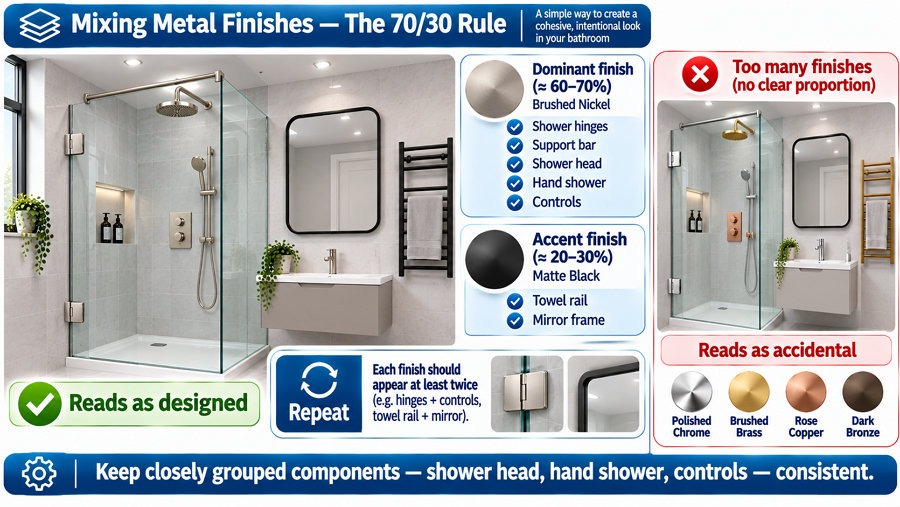
Chrome remains the safest match where tapware is polished chrome: low visual risk, but cold in warm schemes. Brushed Nickel works as a low-contrast dominant finish, pairing cleanly with chrome as an accent or as a softer alternative to polished nickel. Satin Brass and Bronze belong with warm tapware — brass, bronze, or copper — and Bronze in particular adds depth and character to a neutral bathroom. Matte Black is the wild card: technically neutral, it grounds almost any palette and hides fingerprints and water spots better than polished chrome, though it shows dust, soap, and grease, so it rewards frequent light wiping.
The professional rule for mixed metals is proportion, not prohibition. Give roughly 60–70% of the visible metal to one dominant finish, one accent metal, and repeat every finish at least twice so the combination reads as designed rather than accidental. Keep closely grouped components — shower head, hand shower, and controls — consistent, and let the shower hardware echo the tapware rather than compete with it.
Finish Maintenance Realities for UK Bathrooms
Brushed finishes hide watermarks and fingerprints better than polished ones, which makes Brushed Nickel the easiest finish to live with in a busy family bathroom. Matte and powder-coated finishes should be cleaned with mild soap and a soft cloth only — bleach, vinegar, citrus, and abrasive pads will dull or strip them. Chrome is the most forgiving in high-traffic rooms but shows water spots between cleans, so it suits clients who wipe down after use.
Support Bars and Bracing: When Are They Required and How to Specify Them
Support bars are the least glamorous hardware category and the one most often value-engineered out. That is a mistake, because bracing is a safety and compliance item, not a finishing touch.
Do You Need a Shower Screen Support Bar?
A tall fixed glass panel needs a stabilising element. Without one, the panel flexes under normal use, and that movement eventually transfers into the clamps, wall fixings, and seals. The support bar—also called a stabilising bar, bracing bar, or support arm in UK trade usage—links the top of the glass to a wall or ceiling, limiting unwanted movement. Walk-in and wet-room screens almost always require one; frameless hinged doors in a full enclosure may not.
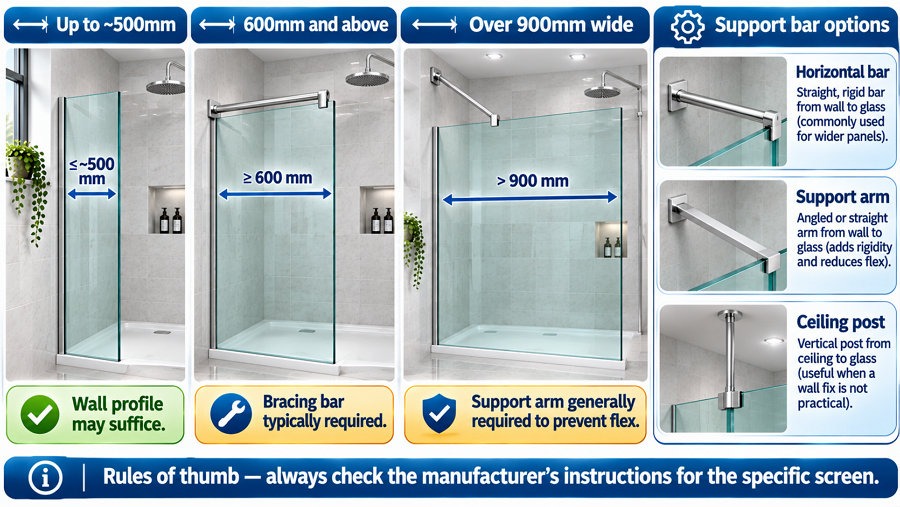
There is a practical UK sizing convention worth knowing: panels up to around 500 mm can sometimes be supported by a wall profile alone, while panels of 600 mm and above typically require a bracing bar. Frameless screens over 900 mm wide generally require a support arm fixed to the wall to prevent glass flex. These are rules of thumb, not substitutes for the manufacturer’s instructions for the specific screen.
When a Support Bar Is Required
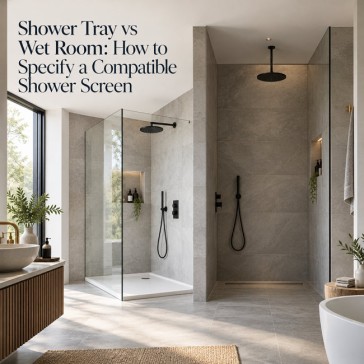
Walk-in and wet-room screens that do not reach the ceiling generally require a support bar, ceiling post, or equivalent stabilising system. UK supplier guidance is consistent: panels up to around 500 mm can be supported by a wall profile alone, panels of 600 mm and above require a bracing bar, and frameless screens over 900 mm wide require a support arm fixed to the wall to prevent glass flex. Bracing also contributes to structural stability in line with Requirement K4 of the Building Regulations 2010, which deals with protection against impact with glazing — including shower screens.
Support Bar Types and Glass Thickness Compatibility
The horizontal wall-to-glass bar is the most common solution for walk-in and wet-room screens, with telescopic designs covering spans from roughly 700 mm to 1,200 mm and fitting glass from 8–12 mm depending on the model. Ceiling posts are used where a suitable wall is not within reach or where a horizontal bar would obstruct the showering area. CRL’s square-cornered support bar brackets suit 10–12 mm glass, so the bracket must be checked against the panel, not assumed to match the hinge range. Bellagio support bars are available in the coordinated finish palette, including Matt Black and Brushed Bronze.
Installation and Aesthetic Considerations
Fixings must avoid overhead showers, concealed services, and window reveals, and the wall construction should be confirmed before the bar is ordered. Aesthetically, a Matt Black support bar can become a deliberate design line against pale tiles, while Brushed Brass or Bronze ties the bar into a warm scheme. The installer warning is worth stating plainly: a support bar controls stability, not waterproofing. Sealant is not a substitute for mechanical bracing.
Glass Thickness, Load Limits, and Hardware Compatibility: The Installer’s Checklist
UK Glass Thickness Standards for Shower Screens
The UK market splits predictably: 6 mm for framed and semi-framed enclosures, and 8 mm or 10 mm for frameless and walk-in designs, with many specialists treating 8 mm as a minimum and recommending 10 mm for all frameless work. All toughened safety glass should meet BS EN 12150, and complete enclosures should be tested to BS EN 14428, which covers impact resistance, cleanability, and conformity marking. Specifiers should also note that Approved Document K references BS EN 12600 classifications when glazing is in a critical location.
Hardware-to-Glass Thickness Matching
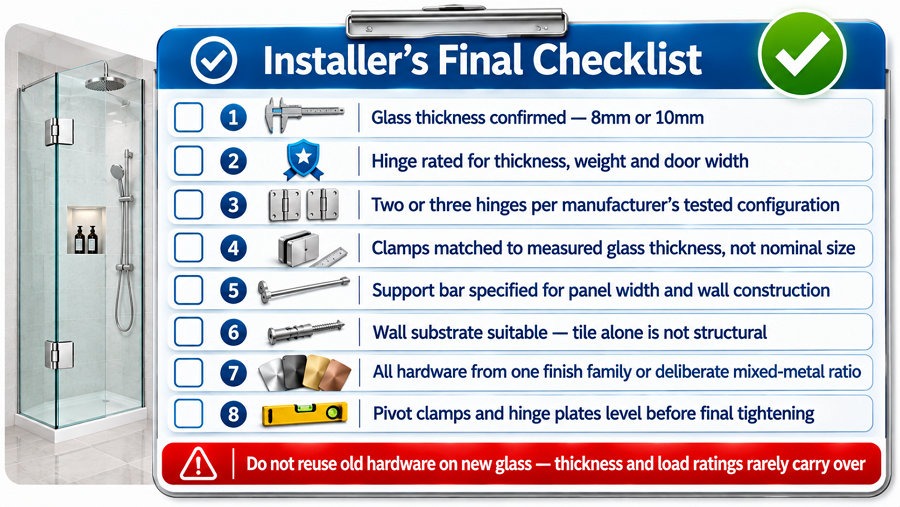
Bellagio hinges: 8–10 mm. Bellagio 90° and 180° glass-to-glass clamps: 8–10 mm. Bellagio Stabilizer Angle Bracket: 8–10 mm. CRL square-cornered support bar bracket: 10–12 mm. If the glass thickness changes, the hardware must change with it. Forcing an 8 mm fitting onto a 10 mm panel is not a workaround; it is a failure waiting for a call-back.
Door Weight, Hinge Count, and Maximum Width
Two Bellagio hinges carry 50 kg up to a 1,000 mm door width. Comparable ranges sometimes quote 54 kg or 63 kg with three hinges, but those figures are tested configurations for specific products — they are not a general upgrade path. Always use the manufacturer’s tested hinge count for the actual door. On site, check that pivot clamps and hinge plates are level before final tightening; misalignment reduces clamping force and causes the door to drift out of its zero position.
Common Specification and Installation Mistakes to Avoid
On the design side, three mistakes recur. The first is specifying “bronze” without confirming which bronze — Brushed, Gold, Rose, or Dark — because finish names are not consistent between manufacturers. The second is ignoring maintenance reality: polished chrome shows water spots, matt black shows soap streaks, and brushed finishes hide marks but need grain-aware cleaning. The third is over-mixing metals; more than two finishes without a dominant proportion reads as accidental rather than curated.
On the installation side, the most serious mistake is reusing old hardware on new glass. Hinges and clamps are matched to thickness and load, and a fitting from a previous installation is rarely an exact match. The second is skipping the support bar on a walk-in screen, which leaves the glass vulnerable to flex and impact. The third is fixing into an unsuitable wall — lightweight partitions and timber studs need cavity fixings and, sometimes, additional framing before tiling.
FAQs: Shower Screen Hardware Questions UK Buyers Ask
What hinges are best for a frameless shower screen?
Wall-to-glass hinges suit recessed enclosures and bath screens where one side is a solid wall; glass-to-glass hinges suit corner enclosures and return configurations. Use 90° hinges for right-angle joins and 180° hinges where a panel needs to sit flush. The decisive factor is the hinge’s tested weight and door-width rating for the glass thickness being installed, not the hinge style alone.
Do I need a support bar for a walk-in shower screen?
Yes. A fixed walk-in or wet-room glass panel requires a stabilising element—a horizontal support bar, support arm, or ceiling post—to prevent movement. As a UK rule of thumb, panels around 500 mm may be supported by a wall profile alone, while panels of 600 mm and above typically require a bracing bar; frameless screens over 900 mm wide generally need a wall-fixed support arm.
What is the best finish for shower screen hardware?
Polished chrome is the most versatile and lowest-risk UK default. Matt black makes the strongest contemporary statement and hides fingerprints well. Brushed brass is the warmest and most design-led option, while brushed nickel offers a softer, low-maintenance alternative to chrome. The “best” finish is the one that coordinates with the rest of the bathroom’s brassware and suits the water and cleaning regime.
Can I mix Chrome hardware with Brushed Nickel taps?
Yes, if the mix is deliberate rather than accidental. The professional rule is proportion: give roughly 60–70% of the visible metal to one dominant finish, add one accent metal, and repeat each finish at least twice so the combination reads as designed. Brushed Nickel works particularly well as an accent against chrome because it is a low-contrast, low-maintenance finish that softens the coldness of polished chrome without competing with it. Keep closely grouped components — shower head, hand shower, and controls — consistent, and let the shower hardware echo the tapware rather than introduce a third or fourth metal into the same sightline.
What glass thickness is standard for a frameless shower screen in the UK?
The UK market splits predictably. Standard shower screen glass is 6 mm or 8 mm for framed enclosures, and 8 mm or 10 mm for frameless and walk-in designs. Many specialists treat 8 mm as the minimum standard and recommend 10 mm for all frameless installations, because thicker glass feels more substantial, produces less vibration when the door closes, and has a more premium aesthetic. All toughened safety glass should be manufactured to BS EN 12150, and complete enclosures should be tested to BS EN 14428, which covers impact resistance, cleanability, and conformity marking. Frameless doors in the UK are commonly available in 8 mm, 10 mm, and 12 mm toughened glass.
Ready to specify the right screen for the job? Explore the full range of frameless, walk-in, wet-room, and bath shower screens at Elegant Showers UK, including 8 mm toughened safety glass options, adjustable wall profiles, and coordinated bracing arms — with free delivery to UK mainland and UK-based customer support. Whether you need a Matt Black wet-room panel, a reversible frameless enclosure, or a replacement screen that actually fits an out-of-true wall, the specification starts there.


Validate your login