

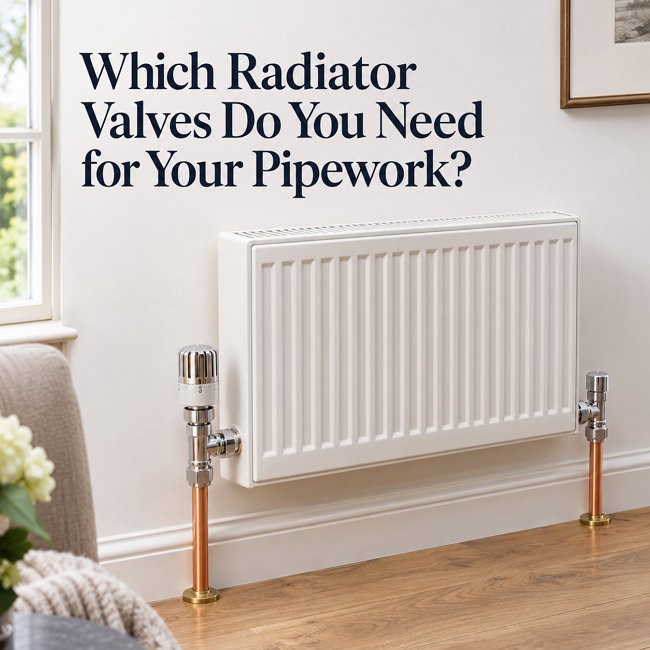
Choosing the wrong radiator valve is more than a minor DIY frustration. It wastes heat, drives up energy bills, and in some cases breaches Building Regulations. The good news is that the decision comes down to two separate questions, and neither is as complicated as it first appears. You need to identify how you want to control the heat (the control type) and how your pipes physically meet the radiator (the valve shape and pipe size). Get those two right, and everything else—finish, brand, price—is a style choice. This guide walks you through both decisions step by step, with the UK-specific rules and pipework quirks that actually matter.
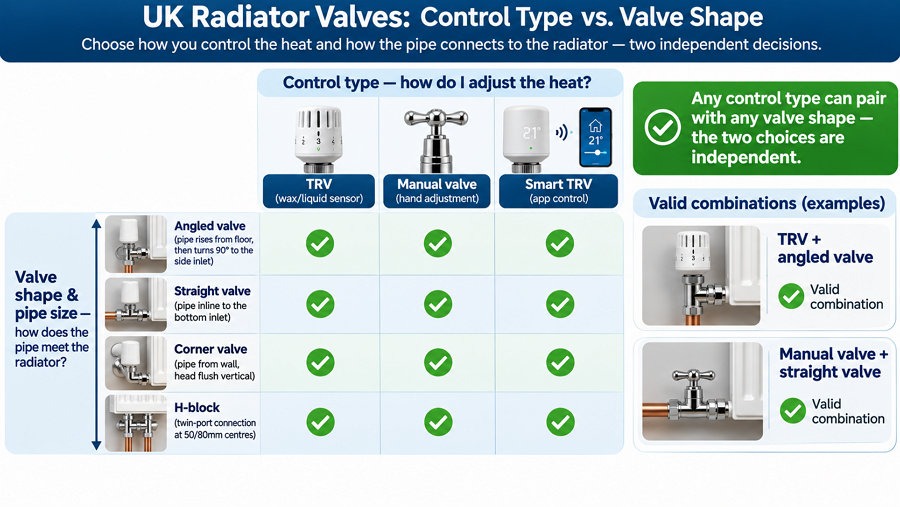
The Two Decisions That Determine Which Radiator Valves You Need
Every radiator has an entry and an exit for water, so it needs a valve on each side. In simple terms, you fit one user-adjustable control valve on the flow side and one lockshield valve on the return side. The control valve is the one you touch to adjust heat. The lockshield sits under a plain cap and is set once during balancing, then left alone.
The two decisions that follow are independent. Control type is about function: do you want the valve to respond automatically to room temperature, or do you want to open and close it by hand? Valve shape and pipe size is about geometry: at what angle does your pipe approach the radiator, and what is the outside diameter of that pipe? A valve can be thermostatic and angled, or manual and straight—the two choices do not constrain each other.
Radiator Valve Control Types: TRV vs Manual vs Smart
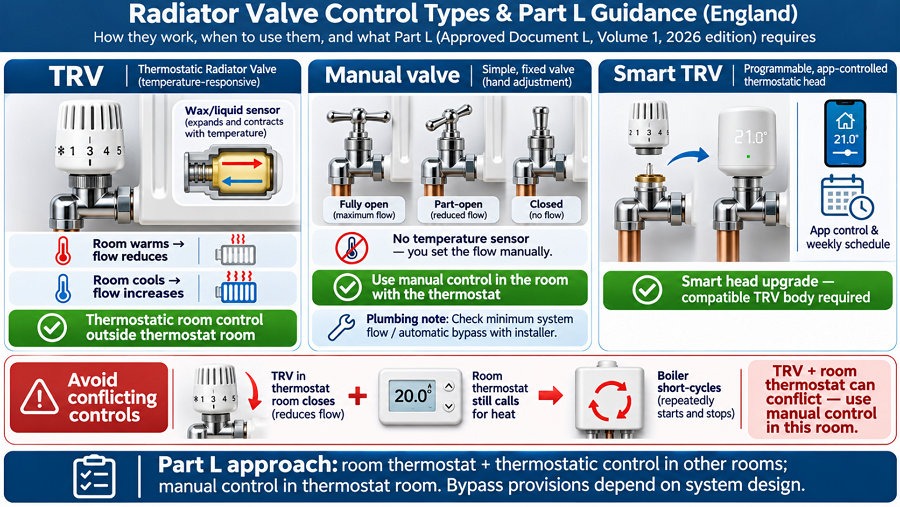
The control type you choose determines how you interact with your heating system day to day. It is the "how do I adjust the heat?" decision, and it sits entirely separately from the "how does the pipe meet the radiator?" decision covered later. You can pair any control type with any valve shape, so do not let one choice constrain the other. What follows is a detailed breakdown of each control type, including the UK regulations that govern them, the practical pros and cons, and the situations where each one is genuinely the right answer rather than just the cheapest option.
Thermostatic Radiator Valves (TRVs): The UK Default for Room-by-Room Control
A thermostatic radiator valve contains a wax or liquid sensor that expands and contracts as the room temperature changes. As the room warms, the sensor reduces the flow of hot water; as it cools, flow increases. Most TRVs feature a numbered dial, typically marked from a frost setting up to 5, and the higher the number, the more heat the radiator emits.
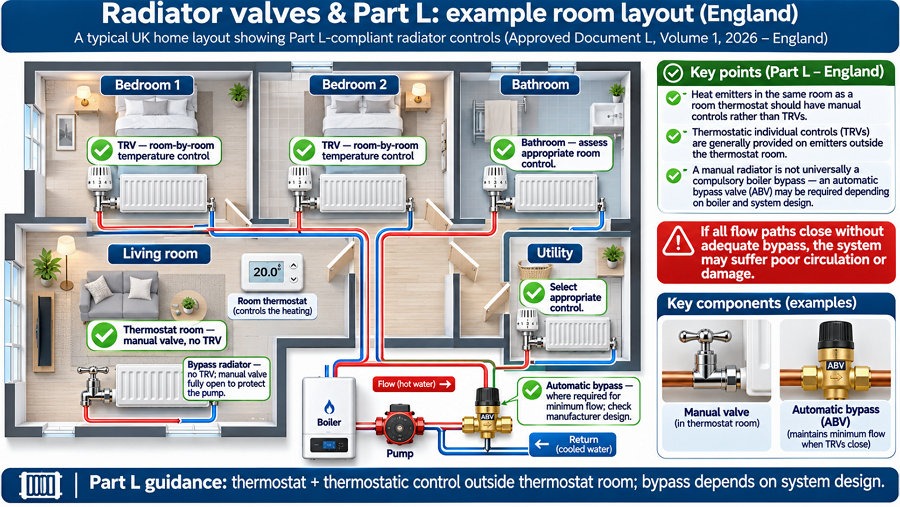
TRVs are the default choice in most UK homes for a straightforward reason: Building Regulations Part L (Approved Document L) requires them on new and replacement radiators, with one specific exception. The exception is the radiator in the room that contains the main room thermostat. That radiator must stay on a manual valve, because a TRV fighting a room thermostat creates “hunting” conflicts—the TRV closes, the thermostat calls for heat, and the boiler short-cycles unnecessarily. Everywhere else—bedrooms, living rooms, studies—a TRV gives you room-by-room temperature control that a single central thermostat cannot.
Manual Radiator Valves: Simple, Cheap, and Sometimes Mandatory
A manual valve works like a tap. You turn it fully open, fully closed, or part-open by hand. There is no sensor and no automatic adjustment. Manual valves are cheaper than TRVs and have fewer moving parts to fail, which makes them useful in utility rooms, cupboards, or anywhere fine temperature control matters less.
Crucially, at least one radiator in the system must stay on a manual valve to act as a permanent boiler bypass. If every radiator had a TRV, and every TRV closed at once, the boiler would have no circulation path. Pressure would build, and the system could be damaged. That bypass radiator is usually the one in the room with the room thermostat, which aligns neatly with the Part L exception.
Smart TRVs: App-Controlled Zonal Heating
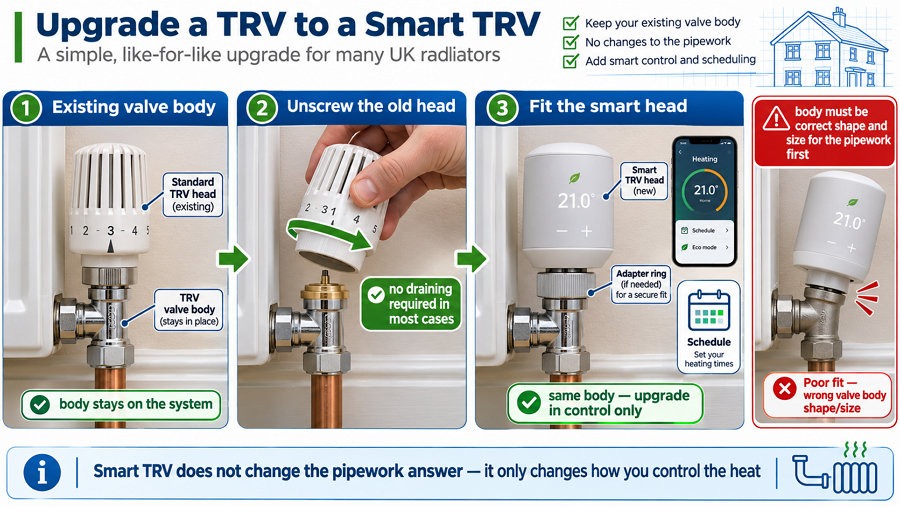
A smart TRV is not a completely different valve. It is a TRV head that replaces the standard thermostatic head on an existing valve body. In most cases, upgrading requires no draining of the heating system—the old head unscrews and the smart head fits onto the same body, often with an adapter. The smart head connects to an app or smart thermostat and lets you set schedules and zones remotely.
Smart TRVs are best suited to homes where occupancy is irregular—a home office used three days a week, a spare bedroom, or a room that overheats in the afternoon sun. They are an upgrade in control, not a different answer to the pipework question. If your existing valve body is the correct shape and size for your pipes, a smart head can go straight onto it.
Which Control Type Should You Choose for Your Pipework?
If you are replacing a valve like-for-like, match the control type to the room’s role. Fit TRVs everywhere except the thermostat room, where a manual valve serves as the bypass. If you are starting from scratch, the same logic applies. The valve shape and pipe size are determined separately, in the next section.
Angled Radiator Valves: The UK’s Most Common Valve for Floor-to-Side Pipework
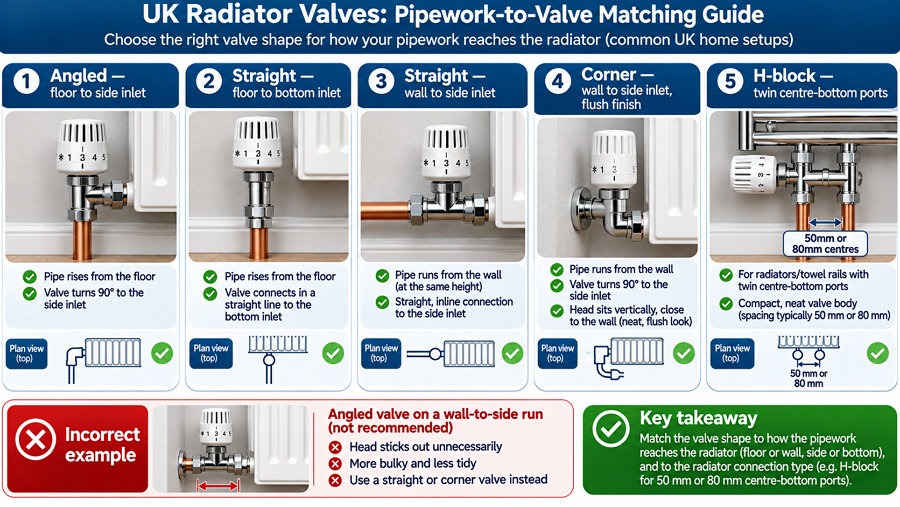
An angled valve turns the pipe through 90 degrees. It is the standard solution when pipework rises vertically from the floor and the radiator inlet is on the side. The valve makes the turn neatly against the skirting board, concealing the pipework and giving a clean finish. Angled valves are, by a wide margin, the most common valve type in UK homes.
The rule is straightforward: floor pipe to side inlet = angled. This is the configuration you will find in the majority of UK living rooms and bedrooms, where pipes come up through the floorboards and connect to the lower side ports of a standard panel radiator.
Straight Radiator Valves: Inline Connections for Floor-to-Bottom or Wall-to-Side Routes
A straight valve connects the pipe and the radiator inlet in a straight line, with no bend. The most common use is when pipework rises vertically from the floor directly beneath a bottom-inlet radiator or towel rail. The pipe meets the inlet head-on, and the straight valve simply joins the two.
A straight valve is also the correct choice when pipework runs horizontally along the wall or skirting and enters a side-inlet radiator at the same height. The key is that there is no change of direction required: the pipe and the inlet are already aligned.
Corner Radiator Valves: The Neat 90-Degree Solution for Wall Pipes
A corner valve also turns the pipe through 90 degrees, but it differs from an angled valve in how the valve head sits. With a corner valve, the head sits vertically, flush against the wall, rather than protruding outward. This makes it the neater choice when pipework emerges horizontally from the wall and connects to a side-inlet radiator, especially in tight spaces or where a clean, minimal look matters.
The practical distinction: both angled and corner valves change direction by 90 degrees, but angled is for pipes rising from the floor, while corner is for pipes coming out of the wall where a flush finish is preferred.
H-Block Radiator Valves: The Compact Twin-Port Solution
An H-block valve combines the flow and return connections into one compact unit, joining two closely spaced ports on a centre-bottom or middle-connection radiator. Designer radiators and some towel rails use this configuration, with the two ports typically set at 50mm or 80mm centres.
H-block valves are available in angled and straight versions. The same pipework logic applies: if the pipes come through the wall to a middle-connection radiator, choose an angled H-block; if the pipes come up from the floor, choose a straight H-block. The H-block saves space by doing the job of two separate valves in one body.
Radiator Valve Pipe Sizes: 15mm, 10mm, and 8mm Microbore
The pipe size is the measurement that decides whether a valve will physically fit onto your heating system. Get the control type right and the valve shape right, but choose the wrong pipe size, and the valve simply will not connect without adapters—or worse, it will connect badly and leak. The good news is that the UK uses a small, well-defined set of pipe sizes for radiator branch pipework, and once you know which one you have, the valve choice narrows immediately.
Standard 15mm Pipework: The UK Default
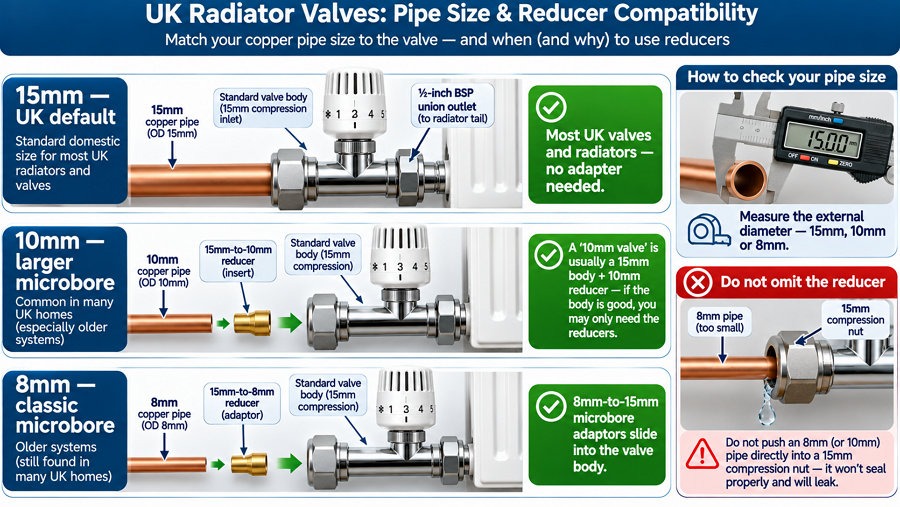
Fifteen millimetres is the standard size for most UK domestic heating branch pipework, including radiator feeds. The vast majority of radiator valves sold in the UK are 15mm valves: they have a 15mm compression inlet for the pipe and a ½-inch BSP union outlet that fits the standard radiator tail used on virtually all UK radiators and towel rails.
If your pipe measures 15mm externally and your radiator has standard ½-inch BSP tappings—which almost all UK radiators do—a standard 15mm valve will fit. There is no need to overcomplicate it.
10mm Microbore Pipework: Older Systems and Smaller Radiators
Ten millimetres is often described as “larger microbore.” It appears in some older UK heating systems and in certain smaller installations. Here is the practical point that saves confusion: a “10mm valve” is usually a standard 15mm valve body supplied with 10mm reducers. The reducer slides into the 15mm compression nut and accepts the 10mm pipe. If you already have a 15mm valve body in good condition, you may only need the reducers, not a complete new valve.
8mm Microbore Pipework: The Smallest UK Size
Eight millimetres is the classic microbore size, common in UK heating systems installed from the 1970s through to the 1990s, and still found in some new builds that use manifold-based microbore layouts. As with 10mm, 8mm valves are typically 15mm bodies with 8mm reducers. Dedicated 8mm-to-15mm microbore adaptors are widely available and simply slide into the valve body, allowing the 8mm pipe to be compressed in the usual way.
How to Measure Your Pipe Size Accurately
Measure the external diameter of the copper or plastic pipe with a tape measure or, for certainty, a vernier caliper. If it reads approximately 15mm, 10mm, or 8mm, you have your size. Be aware that older imperial pipe may not correspond exactly to metric sizes, and in that case, taking a short section of pipe or a clear photograph against a tape measure to a plumbing supplier is the safest route.
The Final Words
The right radiator valve is the one that matches both your pipe route and your pipe diameter. Work through it in order: decide the control type (TRV for most rooms, manual for the thermostat-room bypass), identify where the pipe comes from and where the radiator inlet sits, and then confirm the pipe size. The golden rules bear repeating: floor-to-side = angled; floor-to-bottom = straight; wall-to-side = corner; twin centre-bottom = H-block. Fit a lockshield on every return, keep one manual bypass radiator for Part L compliance, and the system will be efficient, balanced, and easy to live with.
If you have worked through that checklist and you are ready to buy, Elegant Showers stocks a practical range of radiator valves to suit the most common UK pipework configurations. For larger installations or multiple radiators, Elegant Showers also offers thermostatic angled valve sets with lockshields in chrome, anthracite, and white, allowing you to match the valve finish to your radiator or towel rail across the home. All valves are compatible with standard UK heating systems, whether tank-fed or combi.
Browse the full radiator valve range and matching accessories at https://www.elegantshowers.co.uk/, where you can also find the guide on how to choose the right radiator valves if you want to double-check your measurements before ordering. Everything beyond the pipework requirements—chrome, white, anthracite, traditional or modern—is a style choice, and Elegant Showers gives you the options to finish the job properly.





Validate your login