

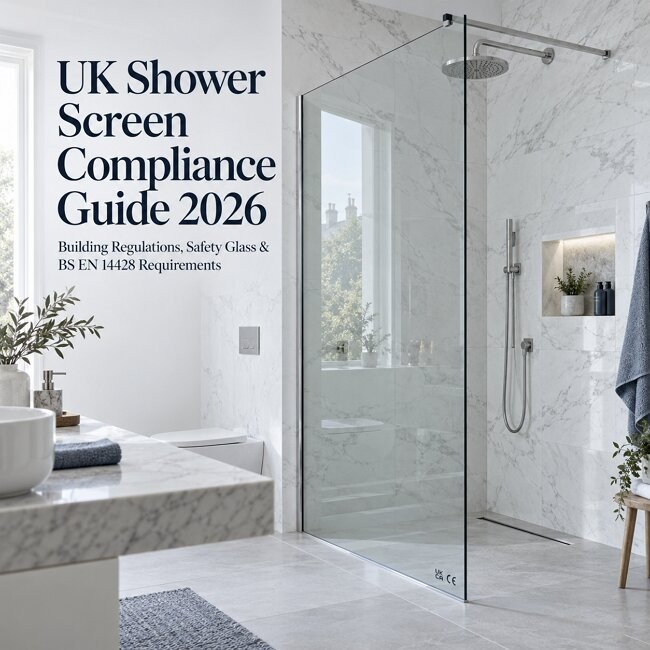
If you are installing or replacing a shower screen in the UK in 2026, compliance is not optional. From British Standards testing to Building Regulations Approved Documents, every shower enclosure sold and fitted in Great Britain must meet a specific set of legal requirements designed to protect users from impact injuries, water damage, and structural failure. This comprehensive guide covers everything you need to know about UK shower screen compliance, including the latest 2026 updates on waterproofing and tanking requirements.
UK Shower Screen Compliance 2026: What Are the Legal Requirements?
There is no single piece of legislation called the “UK Shower Screen Regulations”. Instead, shower screen compliance can involve several overlapping requirements covering the product, safety glazing, installation and the building in which the screen is installed.
A shower enclosure supplied in the UK should therefore be assessed as a complete system, not simply as a sheet of glass.
A practical UK shower screen compliance checklist should consider:
- the relevant BS EN 14428 shower enclosure specification; suitable safety glazing and impact performance; appropriate glass thickness for the designed system; secure hinges, brackets, channels and structural fixings; watertightness and durability; manufacturer installation instructions; relevant Building Regulations or national building standards; applicable CE, UKCA or UKNI requirements; and supporting product documentation such as the Declaration of Performance where required.
Compliance requirements can differ depending on the product, installation, building type and UK nation.
UK Shower Screen Regulations and Building Regulations in 2026
UK Building Regulations should not be confused with British Standards. A British Standard does not automatically become a law simply because its number appears on a product specification. Standards are commonly used to demonstrate recognised levels of performance, while legislation and statutory building requirements determine the legal obligations that apply to a particular product or project.
For England, Approved Document K: Protection from Falling, Collision and Impact provides guidance relating to protection against impact with glazing. Its guidance references BS EN 12600 classifications when considering glazing in critical locations.
The product-market side is separate. Construction products in Great Britain remain governed by the applicable construction products regulatory framework. UK Government guidance identifies the Construction Products Regulations 2011 as the relevant current legislation for this sector.
This distinction matters. A shower screen could carry appropriate product documentation but still be incorrectly installed. Conversely, professional installation cannot compensate for a product that lacks the required performance or conformity documentation.
BS EN 14428: The Core Shower Enclosure Standard
BS EN 14428:2015+A1:2018 is the British Standard that specifies functional requirements and test methods for shower enclosures for domestic purposes. It is the UK implementation of EN 14428:2015+A1:2018 and supersedes all previous versions, including BS EN 14428:2015 (which is withdrawn) and BS EN 14428:2004+A1:2008.
What BS EN 14428 Tests For
BS EN 14428 covers:
-
Impact resistance and shatter properties of glass and other materials
-
Cleanability requirements for surfaces
-
Marking, labelling, and evaluation of conformity
Products tested and certified to BS EN 14428 demonstrate that they meet the functional and safety requirements for domestic shower enclosures when installed in accordance with the manufacturer's instructions. This is the standard that manufacturers and suppliers cite in product documentation, and it is the primary certification that building control officers and specifiers look for.
BS EN 12150: Toughened Safety Glass
All glass used in UK shower enclosures must be toughened (tempered) safety glass manufactured to BS EN 12150. Toughened glass is heat-treated to be approximately four to five times stronger than standard annealed glass, and if it breaks, it shatters into small, blunt pieces rather than sharp shards. This is a non-negotiable safety requirement — never accept a shower screen made from standard float glass.
Products certified to BS EN 12150 are tested for impact resistance, fragmentation behaviour, and thermal shock resistance. Always verify that the glass carries this certification before purchase or installation.
BS 6206: Safety Glass Classification
BS 6206 is the British Standard that classifies safety glass according to its impact performance. The standard grades are Class A, Class B, and Class C, with Class A being the highest performance grade.
While BS 6206 has been largely superseded by BS EN 12600 for regulatory purposes, it remains widely referenced in product certification and is still used in many building control contexts. For shower screens:
-
Class C is the minimum acceptable grade for standard applications
-
Class B is required where the smaller pane dimension exceeds 900mm
Safety glass to BS 6206 must carry appropriate marking on the glass itself, and flat glass screens to baths and showers should be tested for impact and marked in accordance with the appropriate safety glass markings.
UK Shower Screen Safety Glass Regulations
Does a UK Shower Screen Have to Use Safety Glass?
Safety is one of the most important considerations in shower enclosure design because users can slip, fall or accidentally collide with the glazing.
The correct question is therefore not simply “Is this glass toughened?” but whether the glazing provides the safety and impact performance appropriate to its intended application.
BS EN 12150 Toughened Safety Glass
BS EN 12150-1:2015+A1:2019 covers thermally toughened soda-lime silicate safety glass used in buildings. BSI states that the standard specifies areas including tolerances, flatness, edgework, fragmentation and physical and mechanical characteristics of monolithic flat thermally toughened safety glass.
Toughened shower glass is also frequently described as tempered shower glass. The toughening process increases mechanical and thermal resistance compared with ordinary annealed glass and changes its breakage behaviour.
However, specifying toughened glass alone does not prove that an entire shower screen installation is compliant.
BS EN 12600 Shower Screen Impact Testing
BS EN 12600:2002 establishes a pendulum impact test and classification system for flat glazing used in buildings.
BSI explains that BS EN 12600 classifies glass according to impact performance and breakage behaviour. Its safety objectives include reducing cutting and piercing injuries and assessing the material's containment characteristics.
This makes BS EN 12600 especially relevant when discussing shower screen impact resistance and glazing in locations where human impact is foreseeable.
BS 6262-4 Safety Glazing
BS 6262-4:2018 is a code of practice concerning safety related to human impact.
It provides recommendations for glass and plastic glazing materials in locations likely to experience accidental human impact, with the objective of reducing impact-related injuries, particularly cutting and piercing injuries.
Together, BS EN 12150, BS EN 12600 and BS 6262-4 provide important context when specifying safety glass for bathrooms, shower doors and shower enclosures.
UK Shower Screen Glass Thickness Requirements
What Is the Minimum Shower Screen Glass Thickness in the UK?
There is no single universal statutory minimum shower screen glass thickness that can safely be applied to every UK shower enclosure.
Claims such as “all UK shower screens legally have to be 6 mm” or “8 mm glass is required by Building Regulations” oversimplify the issue.
BS EN 14428 is primarily performance based and explicitly does not prescribe general dimensional characteristics.
Suitable shower screen glass thickness depends on factors such as panel dimensions, framing, hinge configuration, bracket locations, support bars, glass type and the manufacturer's tested system.
6mm vs 8mm vs 10mm Shower Screen Glass
6mm shower glass can be used in appropriately engineered systems, particularly where profiles or framing provide additional structural support.
8mm shower glass is frequently used for frameless and semi-frameless shower screens because it provides additional rigidity while remaining practical for common bathroom installations.
10mm shower glass is often selected for larger or more substantial frameless panels, although increased thickness also means greater weight and higher loads on brackets, walls and hinges.
Thicker glass is therefore not automatically “more compliant”. The entire system must be suitable for the panel dimensions and intended installation.
UK Shower Screen Compliance Checklist 2026
Use this practical checklist for every shower screen purchase and installation:
-
Confirm glass type — Ensure the glass is toughened safety glass to BS EN 12150 (not standard float glass)
-
Verify enclosure certification — Check the product is tested and certified to BS EN 14428:2015+A1:2018
-
Check UKCA marking — Verify the product carries UKCA marking (and CE marking where applicable), clearly visible and at least 5mm in height
-
Confirm glass thickness — 6mm minimum for framed screens; 8–10mm for frameless designs
-
Verify BS 6206 classification — Class C minimum; Class B for panes with smaller dimension exceeding 900mm
-
Check critical location compliance — If glass is within 800mm of floor level, it must be safety glass
-
Verify wall waterproofing — Ensure tanking meets BS 5385-1 requirements, especially if flow rate exceeds 12 litres per minute
-
Install support bars — Required for screens exceeding 700mm width or with hinged doors
-
Use correct sealant — Mould-resistant, low modulus silicone; allow 24-hour curing
-
Confirm Approved Documents compliance — K (impact), G (water efficiency), C (moisture) as applicable
-
Retain documentation — Keep product certification and installation records for building control
Frequently Asked Questions
Do I need planning permission to install a shower screen in the UK?
No. Fitting a shower screen does not normally require planning permission. However, you must ensure compliance with Building Regulations where applicable, including Approved Documents K, G, and C.
Is 6mm glass legal for a shower screen in the UK?
Yes. 6mm toughened safety glass to BS EN 12150 is permitted for framed shower screens and doors, provided the complete enclosure meets BS EN 14428. For frameless walk-in designs, 8mm is the recommended minimum, and 10mm is typically specified for premium installations.
What is the difference between UKCA and CE marking for shower screens?
UKCA marking is mandatory for products sold across Great Britain and replaced CE marking in the UK market. CE marking remains relevant for Northern Ireland and demonstrates conformity with EU standards. Many shower screens carry both marks to demonstrate dual compliance.
What happens if my shower screen is not compliant?
Non-compliant products can be subject to recall under the General Product Safety Regulations 2005. In 2024, B&Q recalled several shower and bath screen models due to bonding failures that presented injury risks. Non-compliant installations may also fail building control inspection.
Does my shower screen need to be BS EN 14428 certified?
Yes. BS EN 14428:2015+A1:2018 is the harmonised standard for shower enclosures in the UK. Products tested and certified to this standard demonstrate compliance with functional and safety requirements for domestic installations.



Validate your login