


There is nothing more frustrating than ordering a brand-new shower screen, waiting for delivery, and discovering it doesn’t fit. Whether it is too wide for the alcove, too short to contain the spray, or simply the wrong thickness for your fittings, incorrect shower screen measurements are a costly mistake that could have been avoided with a little preparation. In the UK, where bathrooms come in all shapes and sizes—from period properties with sloping ceilings to modern new-builds with standardised layouts—getting your shower screen dimensions right is non-negotiable.
The central question facing every renovator is simple yet surprisingly complex: what shower screen size actually works in a small bathroom? The answer depends on your specific space, your usage habits, and the type of screen you choose. This comprehensive guide covers standard UK sizes, minimum dimensions, screen types, measurement techniques, building regulations, and practical advice to help you make the right choice.
Table of Contents
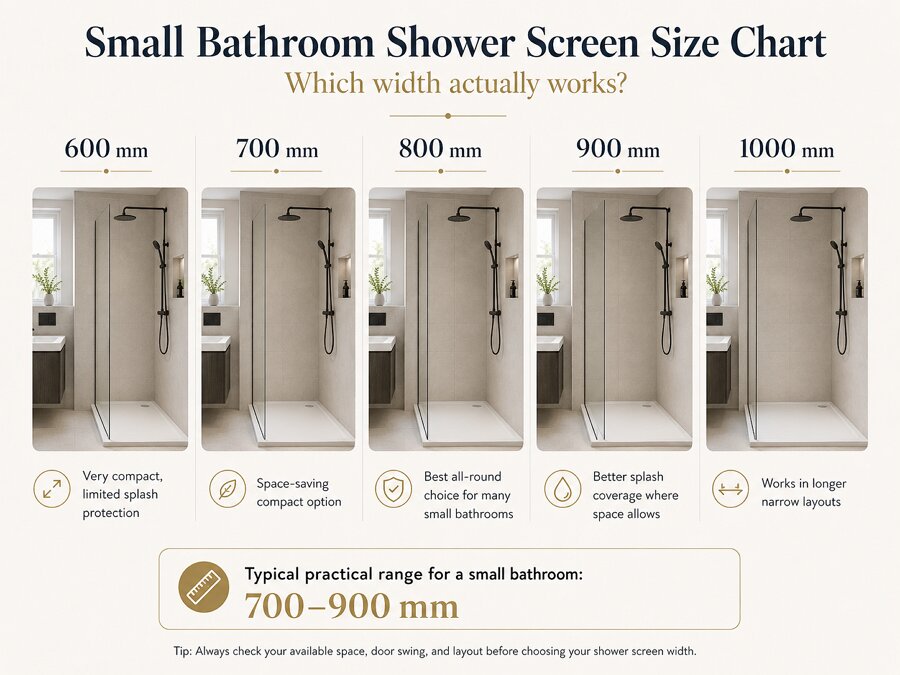
What Size Shower Screen Works Best in a Small Bathroom?
For many compact bathrooms, a shower screen between 700 mm and 900 mm wide works well.
A narrower 600–700 mm shower screen may suit an extremely tight shower room, but it provides less protection from water spray. An 800 mm shower screen is often a useful compromise, while a 900 mm shower screen gives more splash coverage where there is sufficient room.
There is no single standard shower screen size that works for every small bathroom.
The correct size depends on:
- the shower tray width and length;
- whether the shower is enclosed or open;
- the position of the shower head;
- the direction of the water spray;
- the width of the shower entrance;
- nearby sanitaryware;
- whether the screen is fixed, hinged, folding or sliding;
- the available floor area.
For an open walk-in shower, the total shower length is particularly important. You need enough room for both the fixed glass panel and a comfortable entrance.
Small Bathroom Shower Screen Size: Quick Answer
If you are deciding between common shower screen widths, the following table provides a useful starting point.
| Shower screen width | Suitability for small bathrooms | Main consideration |
|---|---|---|
| 600 mm | Very compact spaces | Limited splash protection |
| 700 mm | Small bathrooms | Space-saving but relatively narrow |
| 760 mm | Compact showers | Useful intermediate size |
| 800 mm | Very good all-round option | Balance of access and splash control |
| 900 mm | Good where space allows | Better water containment |
| 1000 mm+ | Larger walk-in showers | Requires more shower length |
For many homeowners, 800–900 mm is the most practical shower screen width for a small bathroom.
That does not mean an 800 mm screen will automatically fit every room. Always measure the finished shower area before ordering.
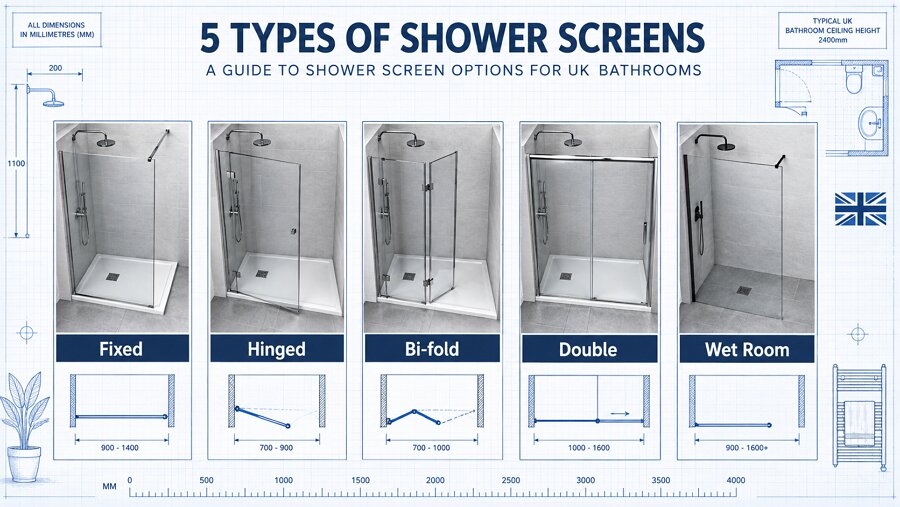
Shower Screen Types for Small Bathrooms
Fixed (Single Panel) Screens
Fixed screens are the most common choice—a single pane of glass permanently attached to the wall. They come in narrow widths from 300mm upwards, making them ideal for cloakrooms and very tight spaces. Fixed screens are simple, sturdy, and very easy to clean. They are ideal for minimalist bathrooms with limited space.
Hinged Screens
Hinged screens pivot on a wall hinge and swing open to give easy access. They typically range from 800mm to 1500mm in width. Compact hinged options as narrow as 300mm are available for small baths. Hinged screens are one of the most popular options because they combine effective splash protection with easy access.
Bi-Fold and Folding Screens
Bi-fold screens fold in a concertina fashion and are ideal for small bathrooms. A 700mm bi-fold fits recess widths of 650–690mm. The door folds inward to maximise floor area, making it perfect for ensuites or smaller bathrooms where a standard opening is not practical. Folding screens require no large clearance space outside the shower area.
Double Panel Screens
Double panel screens hinge in the centre or to one side. They are useful when a full outward-opening screen will not fit. Hinged doors are described as offering a "premium wide opening," while bi-fold doors are known as the "small-bathroom saviour."
Wet Room Screens (Walk-In)
Wet room screens are fixed panels without doors. They typically range from 700mm to 1700mm in width. A 700–800mm wet room screen is perfect for smaller spaces without compromising style or durability. These screens create seamless shower entries with minimal visual interruption.
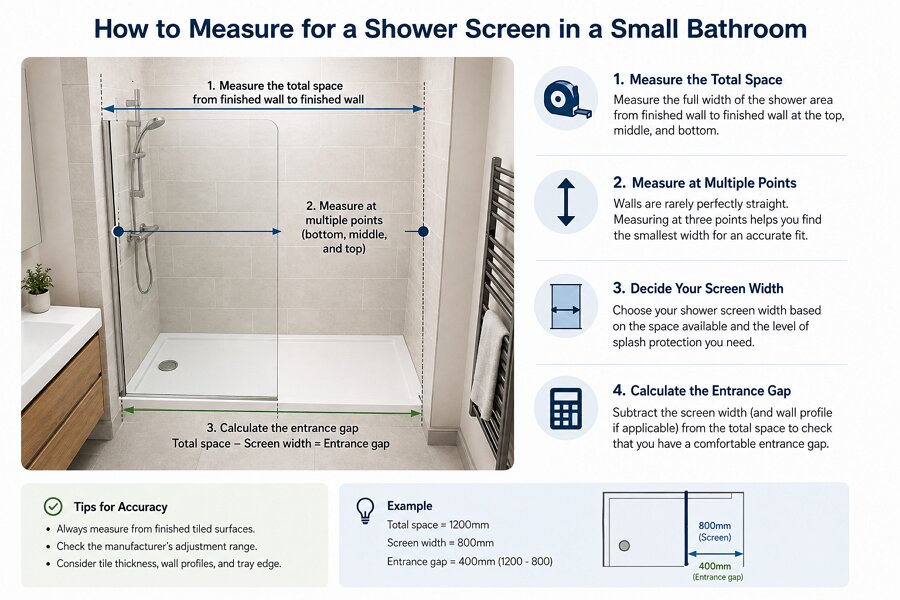
How to Measure for a Shower Screen in a Small Bathroom
Accurate measurement is one of the most important parts of choosing a shower screen.
Do not order simply because the product description says “800 mm shower screen.”
The actual installation range can differ from the nominal size.
Step 1: Measure the Shower Tray or Bath
Measure the finished tray or bath where the screen will be installed.
If the walls have not yet been tiled, remember that adhesive, backer boards and tiles will alter the final dimensions.
Whenever possible, take final measurements after wall finishes are complete.
Step 2: Measure the Available Shower Screen Width
Measure the space at several heights.
Walls are not always perfectly vertical, especially in older UK properties.
Measure:
- near the shower tray;
- around the middle;
- near the top.
Step 3: Check Whether the Wall Is Plumb
Many shower screens include a wall profile with a small adjustment range.
This can compensate for minor variations in wall alignment.
However, the adjustment range varies between manufacturers, so check the technical specification rather than assuming every 800 mm screen fits exactly the same opening.
Step 4: Measure the Shower Entrance
For a walk-in shower, calculate how much space remains after the panel is installed.
A large glass screen is pointless if it leaves an uncomfortable entrance.
Step 5: Check Door and Screen Swing Clearance
If you are buying a hinged screen, check whether it will collide with:
- the toilet;
- basin;
- vanity unit;
- towel radiator;
- bathroom door;
- bath taps;
- nearby furniture.
Step 6: Check the Manufacturer's Fitting Range
Always use the manufacturer's actual installation dimensions rather than relying only on the headline product size.
An “800 mm” screen may have a fitting range slightly above or below that figure depending on its wall profile and hardware.
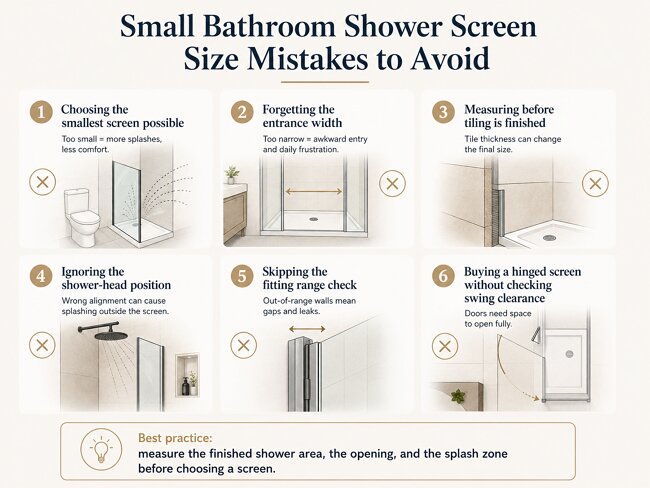
Small Bathroom Shower Screen Size Mistakes to Avoid
Measuring from Bare Walls
The most common mistake is measuring before tiling is complete. Tiling and adhesive change dimensions. Measuring from bare walls will result in a screen that is too wide to fit.
Ignoring Wall Irregularities
Walls are rarely perfectly straight—especially in older UK homes. Only measuring at one point leads to fitting issues. Measure at three points (top, middle, bottom) and use the smallest measurement.
Choosing Too Small a Screen
While 700mm fits on paper, it often feels cramped in practice. Splash protection is compromised with insufficient width. Effective shower screens in showers start at 900mm in width. A 600mm screen may look appealing but offers minimal water protection compared to appropriately sized panels.
Forgetting About Door Swing and Access
Outward-opening doors need clearance space. Inward-folding screens (bi-fold) save space but may reduce the showering area. Always consider how the door opens in relation to other bathroom fixtures like basins and WCs.
Space-Saving Shower Screen Solutions
Bi-Fold and Sliding Doors
Bi-fold and sliding doors save swing space—ideal for tight layouts. Folding panels require no large clearance area outside the shower. Sliding doors in alcoves maximise floor space. For 700–760mm enclosures, a bi-fold door is the most space-saving because it folds inwards and takes up little room when open. Sliding doors work well on 800–900mm units.
Wet Room (Trayless) Setups
Wet room setups have no shower tray, meaning the room feels larger. Fixed panels create an open, hotel-like feel. A 700–800mm screen keeps the space feeling open. Walk-in showers can start from around £1,500 for a simple setup.
Corner and Quadrant Enclosures
Quadrant shower enclosuredesign reclaims elbow room via diagonal space. Corner entry saves wall space. Offset quadrant enclosures are available for corner installations. Pivot, quadrant, and sliding door configurations are designed for compact spaces.
Return Panels ("Flippers")
Return panels are additional panels that prevent splash-out. They allow for a smaller main screen with better protection. For example, a 700mm fixed screen with a 350mm hinged return panel gives a total coverage of 1050mm.
FAQs About Small Bathroom Shower Screen Sizes
What Size Shower Screen Do I Need for a Small Bathroom?
For many small bathrooms, a 700–900 mm shower screen is a useful starting range. An 800–900 mm panel often offers better splash protection, but you should also consider the shower entrance, tray size and shower-head position before choosing.
Is a 700 mm Shower Screen Wide Enough?
Yes, a 700 mm shower screen can be wide enough for a compact bathroom, particularly when space is limited. However, it may provide less splash protection than an 800 or 900 mm panel, especially in an open walk-in shower.
Is an 800 mm Shower Screen Wide Enough?
An 800 mm shower screen is often an excellent choice for small bathrooms. It provides useful water coverage while still leaving reasonable access in many walk-in layouts.
Is a 900 mm Shower Screen Better Than an 800 mm Screen?
A 900 mm screen provides more glass coverage and may reduce water splash. However, it also takes up an additional 100 mm of the
How Wide Should the Opening Be for a Walk-In Shower?
Around 500–600 mm is a commonly used practical starting point for a walk-in shower entrance, although a wider opening can provide more comfortable access. Accessibility requirements may require considerably more space.
What Size Shower Screen Do I Need for a Bath?
Many over-bath shower screens are around 800–900 mm wide. The correct size depends on the bath, shower-head location and direction of the water spray rather than bath length alone.
shower opening. The better size depends on how much entrance width is available.
What Is the Minimum Size for a Walk-In Shower in the UK?
There is no single minimum dimension that suits every walk-in shower. Compact rectangular showers such as 1200 × 800 mm are often considered workable starting points, but open showers need enough length for both the screen and entrance.
Your Next Step: Find the Perfect Shower Screen for Your Space
Now that you know exactly what size and type of shower screen works in a small bathroom, it is time to turn that knowledge into reality.
For a wide selection of shower enclosures, wet room screens, and bath screens designed specifically for UK bathrooms—from compact 700mm walk-in panels to spacious 1200mm wet room screens—visit Elegant Showers UK today.
Why Elegant Showers?
-
Extensive Range: Screens available from 700mm up to 1700mm, with fixed, hinged, bi-fold, and walk-in options to suit every layout.
-
Premium Quality: 8mm easy-clean Nano glass with toughened safety glass certified to BS EN 12150 standards.
-
Custom Sizes: Bespoke options available for period properties and non-standard alcoves.
-
Return Panels: Add a 300mm flipper/return panel to any screen for extra splash protection—perfect for wet rooms and walk-in setups.
-
Free UK Mainland Delivery: On most products, with fast 2–7 working day shipping.
-
Competitive Pricing: Premium screens from as little as £103.99, with regular special offers across the range.
Explore the full collection at www.elegantshowers.co.uk and find the shower screen that fits your space, your style, and your budget.



Validate your login