

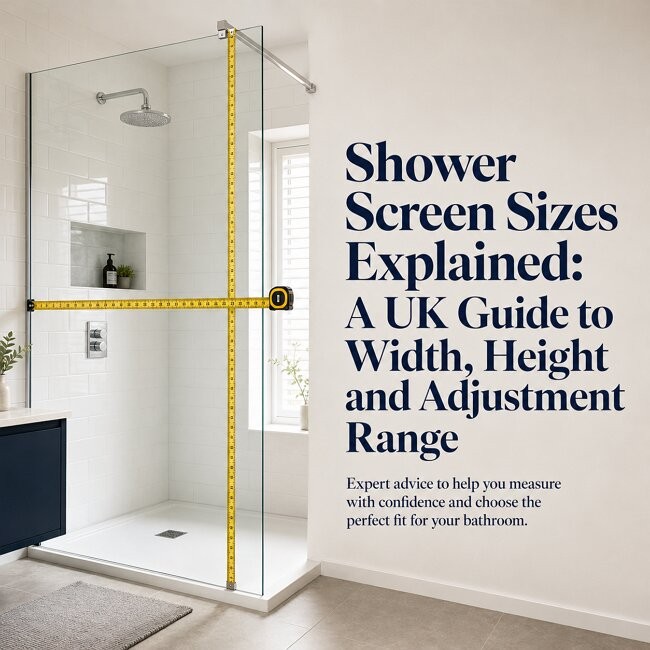
Ordering a shower screenthat doesn't fit is one of the most frustrating—and expensive—mistakes you can make when renovating a UK bathroom. With period properties, uneven walls, non-standard alcoves, and varying tile thicknesses, getting the measurements right requires more than a quick glance with a tape measure.
The reality is that shower screen width, standard shower screen height, and crucially, the adjustment range all work together to determine whether a screen will fit your space. Too many homeowners focus solely on width, only to discover that the height is inadequate for their showerhead or that the walls are too far out of plumb for the screen's adjustment capacity to compensate.
This comprehensive guide covers everything you need to know about UK shower screen sizes—from standard dimensions and adjustment ranges to step-by-step measurement instructions and installation tips. By the end, you'll know exactly how to select the perfect screen for your bathroom, avoiding costly returns and water damage.
Why Shower Screen Sizes Matter in UK Bathrooms
UK bathrooms present unique challenges that make accurate sizing essential. Unlike modern new-build properties with square, plumb walls, many British homes feature sloping floors, non-square alcoves, and walls that have settled over decades. Tiling adds another variable—thickness can vary significantly depending on the adhesive, tile size, and grout lines.
The Cost of Getting It Wrong
A shower screen that doesn't fit properly can lead to:
-
Water damage from gaps that allow splashes to escape
-
Expensive returns with restocking fees and shipping costs
-
Installation delays while you wait for replacement screens
-
Compromised safety if the glass isn't securely fixed
Beyond the Basics: The Adjustment Range Factor
Many buyers don't realise that adjustment range is just as important as the nominal size. This is the band of opening widths that a single screen will fit—for example, a 760mm enclosure with a 20mm adjustment range fits openings from 740mm to 760mm. Understanding this tolerance is what distinguishes a "good fit" from a "perfect seal."
Key takeaway: Success in buying a shower screen depends on understanding width, height, and adjustment tolerance working together.
Standard Shower Screen Sizes UK: Quick Size Guide
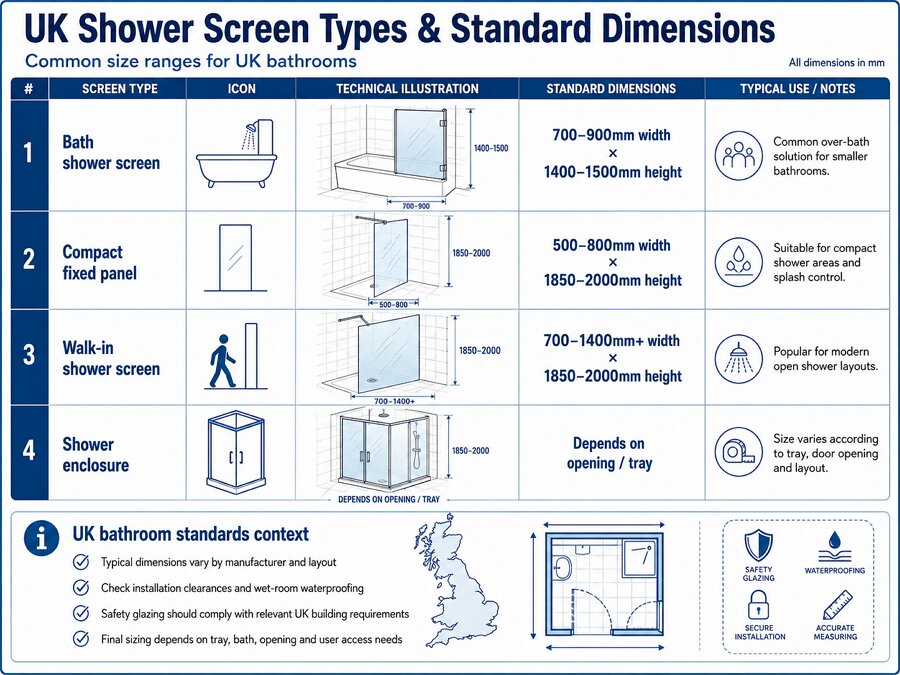
The term standard shower screen size usually means a commonly stocked size rather than an official national dimension. Different manufacturers offer different widths, heights and fitting tolerances, so two products sold as a “900mm shower screen” may not have identical installation dimensions.
| Shower screen type | Common width | Common height | Typical use |
|---|---|---|---|
| Bath shower screen | 700–900mm | 1400–1500mm | Over-bath shower |
| Compact fixed panel | 500–800mm | 1850–2000mm | Small walk-in or wet room |
| Walk-in shower screen | 700–1400mm+ | 1850–2000mm | Walk-in shower or wet room |
| Shower enclosure | Depends on opening/tray | 1850–2000mm | Recess or corner enclosure |
UK Shower Screen Width: The Definitive Guide
Shower screen width refers to the horizontal span of the glass panel(s). The measurement method depends on the type of screen you're installing:
-
Bath screens: Measured along the bath rim from the wall to the desired endpoint
-
Walk-in and wet room screens: Measured between finished wall surfaces
Standard Shower Screen Widths in the UK
UK shower screens come in a wide range of widths to accommodate different bathroom layouts and bath sizes.
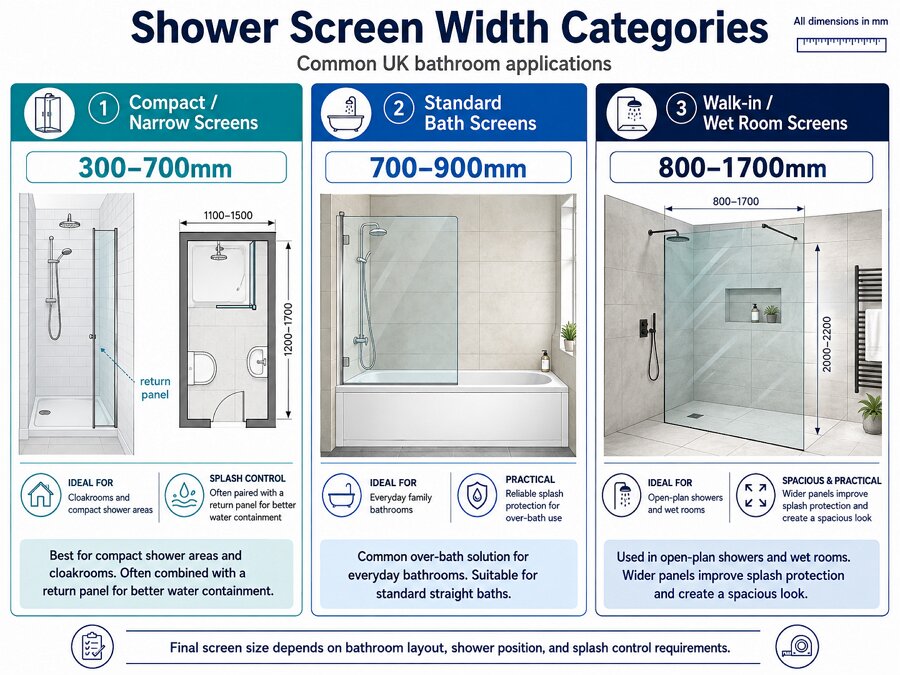
Compact/Narrow Screens (300mm – 700mm)
These are ideal for small cloakrooms, short baths, or as return panels in larger enclosures. Fixed panels can have a minimum width of 300mm, making them suitable for tight spaces where full-width coverage isn't possible or where a return panel is needed to complete an enclosure.
Standard Bath Screens (700–799mm, 800–899mm, 1000–1099mm)
These are the most common sizes for standard straight baths. A 700mm to 800mm panel works for most standard baths, providing good protection without dominating the room. For a standard straight bath, a single 800mm screen usually fits well. Widths also extend to 1000–1099mm and 1200–1299mm for larger baths or those requiring extra splash protection.
Walk-in and Wet Room Screens (800mm – 1700mm)
Walk-in screens offer more flexibility and coverage. Popular sizes include 800mm, 900mm, 1000mm, and 1200mm. Widths range from 700mm up to 1700mm, with 700–900mm suitable for small ensuites and 1200–1400mm working well for family bathrooms.
How to Choose the Right Width
Selecting the correct width involves several considerations:
-
Match to bath length: The screen should cover the area where water splashes most
-
Consider shower spray pattern: Overhead rain showers require wider coverage than handheld units
-
Allow adequate entry space: Aim for a minimum of 600–800mm for comfortable access
UK Shower Screen Height: Standard and Non-Standard Options
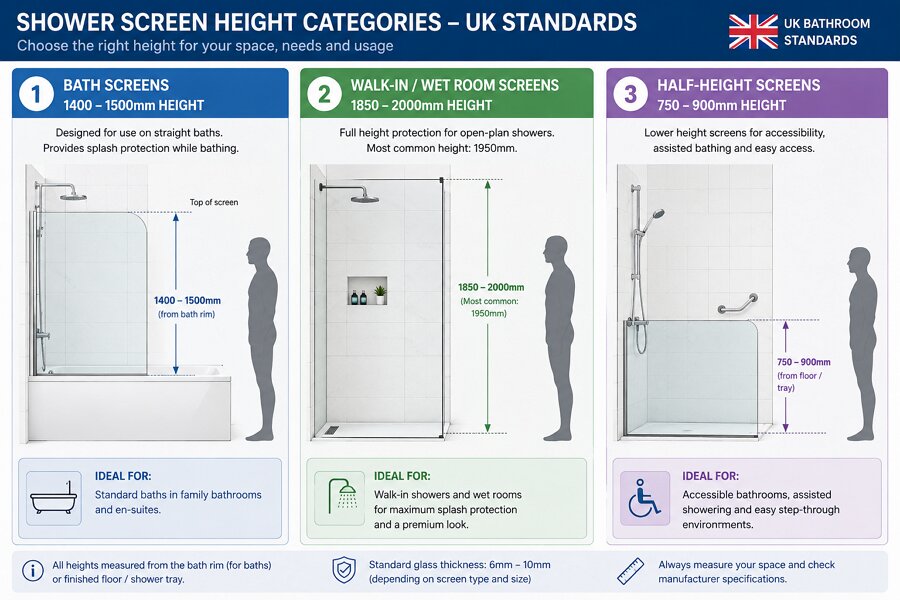
Shower screen height is the vertical measurement from the bath rim (or shower tray) to the top of the screen.
Standard Shower Screen Heights
Bath Screens (1400mm – 1500mm)
Bath screens are typically 1400–1500mm tall. This height is sufficient to contain spray from an overhead shower while remaining practical for installation. The classic height range is 1400–1450mm, with some options reaching 1480–1500mm for more powerful showers. Fixed bath screens can start from around 500mm wide and go up to over a metre.
Walk-in and Wet Room Screens (1850mm – 2000mm)
The standard shower screen height in the UK for walk-in and wet room screens ranges from 1850mm to 2000mm. The most common height is 1950mm, which balances splash protection with installation practicality. This height suits standard UK ceiling heights. Some options are available at 1850mm or 2000mm if you need slightly lower or taller protection. Full-height screens of 1880mm provide a more enclosed feel while maintaining easy access.
Half-Height Screens (750mm – 900mm)
Half-height screens are typically 750mm or 900mm. These are used in accessible or assisted showering setups where the open top keeps a carer dry during assisted showering.
When to Choose Taller Screens
Consider taller screens in these situations:
-
Tall users who need extra splash protection
-
High-pressure showers that create more spray
-
Rainfall showerheads that direct water straight down and create splash at the edges
Ceiling Constraints
In loft conversions or rooms with sloping ceilings, height constraints may limit your options. Always measure from the bath rim to the lowest point of the ceiling or obstruction before ordering.
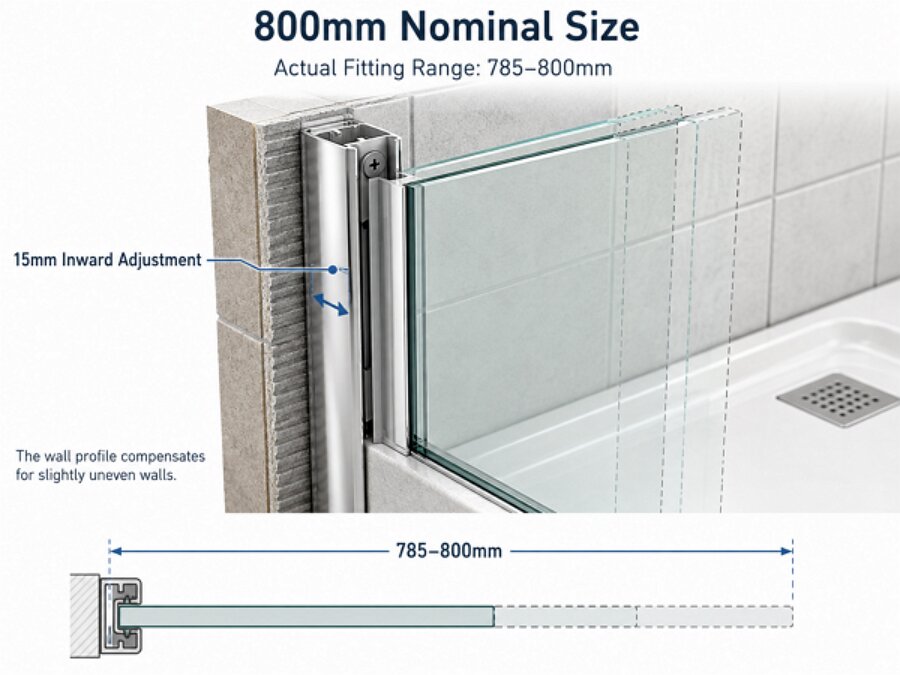
Shower Screen Adjustment Range Explained
Adjustment range is arguably the most misunderstood—and most important—specification when buying a shower screen.
What Is an Adjustment Range?
The adjustment range is the band of opening sizes that a single enclosure will fit. For example, a 760mm enclosure with a 20mm adjustment range will fit any opening between 740mm and 760mm. This flexibility exists because UK walls are rarely perfectly plumb or square—plaster, tiles, and structural shifts add millimetres in unexpected places.
Common Adjustment Ranges in the UK Market
Different products offer varying levels of adjustment:
-
10mm adjustment: Often found in basic DIY models (e.g., 795–800mm)
-
15mm–20mm adjustment: Standard for most quality enclosures. Examples include 875–893mm, 975–993mm, 990–1010mm, and 1190–1210mm
-
14.5mm either side: Compensators set at the mid point to give adjustment inwards and outwards on both sides
-
20mm adjustment: Common in many quality screens
-
40mm adjustment: Found in premium or pivot systems for maximum flexibility (e.g., 660–700mm)
Some screens offer adjustment of 20mm out of true wall on each side, while others provide up to 20mm adjustment total.
How to Use the Adjustment Range Properly
-
Aim for the middle of the range, not the maximum. This gives you room to adjust in both directions.
-
Measure at three points (top, middle, bottom) and use the smallest measurement.
-
Account for tiling thickness—always measure from finished wall to finished wall.
-
Consider both sides—some screens adjust on one side only, while others adjust on both.
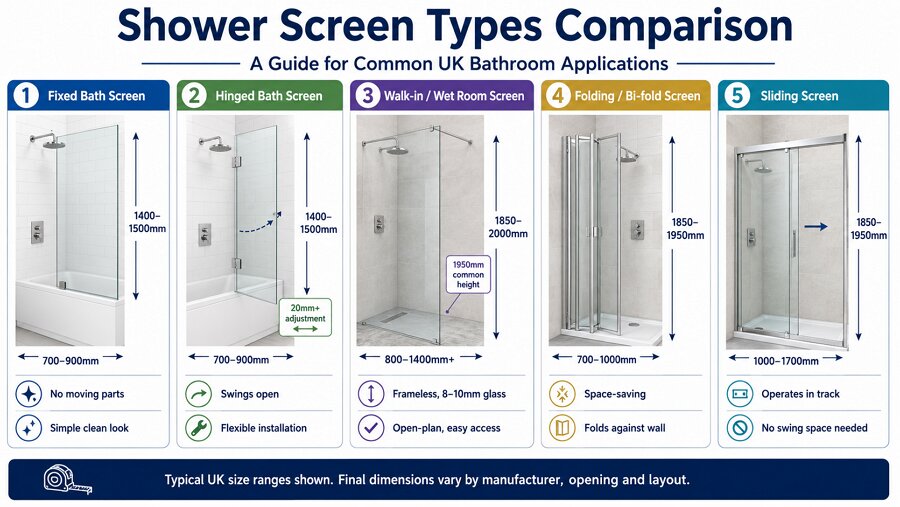
Types of Shower Screens by Size and Configuration
Different shower screen types have different size characteristics and adjustment capabilities.
Fixed Bath Screens
-
Width: 300mm to 1000mm
-
Height: 1300–1400mm
-
Features: No moving parts; simple, clean look
-
Best for: Baths where a hinged door isn't needed
Hinged Bath Screens
-
Width: Typically 700–900mm
-
Height: 1400–1500mm
-
Features: Swings open for easy access
-
Adjustment: Often 20mm or more
-
Best for: Standard straight baths
Walk-in and Wet Room Screens
-
Width: 700–1700mm
-
Height: 1850–2000mm, with 1950mm most common
-
Features: Frameless options available; often use 8mm or 10mm glass
-
Best for: Open-plan showers, level-access wet rooms
Folding and Bi-fold Screens
-
Width: Up to 1500mm
-
Height: Usually 1400mm, ranging from 1380mm to 1500mm
-
Features: Space-saving; folds back against the wall
-
Best for: Tight bathrooms where swing space is limited
Sliding Shower Screens
-
Width: Various, with adjustment built into the track
-
Height: Typically 1900mm
-
Features: Operates within a frame; no swing space needed
-
Best for: Bathrooms with limited clearance
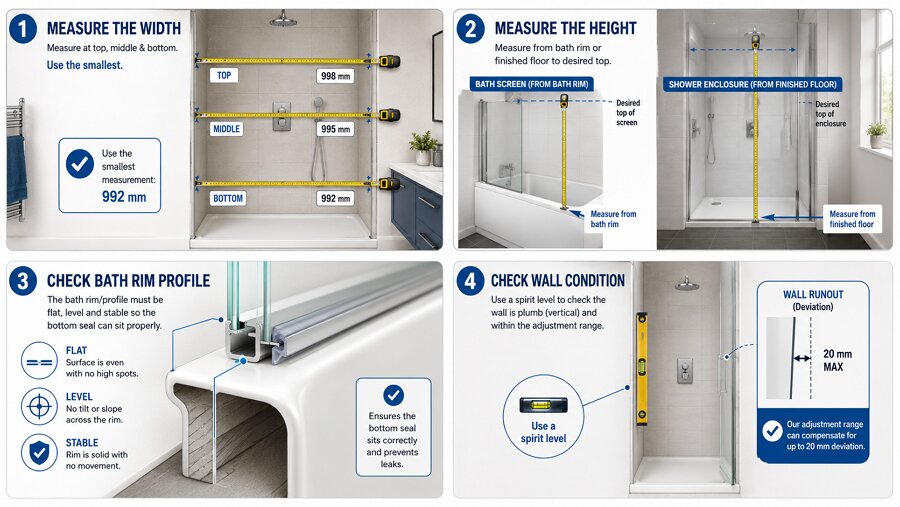
How to Measure for a Shower Screen: A Step-by-Step UK Guide
Accurate measurement is the foundation of a successful shower screen installation. Follow these steps carefully.
Step 1: Measure the Width (The Critical Dimension)
Measure the distance from finished wall to finished wall—tiling must be complete before you measure.
-
Take three measurements: at the top, middle, and bottom of the opening
-
Record the smallest measurement—this is your critical dimension
-
This smallest measurement ensures the screen will fit even if walls aren't perfectly straight
Step 2: Measure the Height
For bath screens:
-
Measure straight upward from the top of the bath rim
-
For walk-in screens, measure from the finished floor or shower tray to the desired top line
Step 3: Check the Bath Rim Profile
-
Ensure the rim is flat and stable for the bottom seal
-
Match the screen shape to your bath type:
-
P-shaped baths require specific screen shapes
-
L-shaped baths need compatible configurations
-
Curved baths need curved screens
-
Step 4: Check the Wall Condition
-
Use a spirit level to check for plumb
-
The adjustment range compensates for minor deviations—typically up to 20mm
-
If walls are significantly out of plumb, consider professional advice
Step 5: Consider Access and Swing Space
-
Allow at least 600–800mm for comfortable entry
-
For hinged screens, check that the door can swing freely without hitting fixtures
-
For sliding screens, ensure the track has enough clearance
Additional Considerations
-
Measure the distance to nearby fixtures (toilet, basin, radiator)
-
Check for slopes or uneven walls
-
Consider any obstructions like windows, towel rails, or pipework
Frequently Asked Questions (FAQs) about Shower Screen Sizes
Does a Shower Screen Have to Be the Same Size as the Shower Tray?
No. The shower tray’s nominal size and the shower enclosure’s actual fitting dimensions are not automatically identical. Match the tray shape and bathroom layout, but verify the enclosure’s published adjustment range rather than assuming matching numbers guarantee compatibility.
How Do I Measure for a Replacement Shower Screen?
Measure the finished opening at the top, middle and bottom. Check the shower screen height from the tray or finished floor and confirm that the walls are reasonably plumb. Compare your finished measurements with the manufacturer’s minimum and maximum fitting dimensions.
What If My Shower Opening Is Between Standard Sizes?
Choose a shower enclosure whose adjustment range includes the finished opening. Some manufacturers also offer compatible extension profiles. If no suitable standard shower screen fits the space, consider a bespoke or made-to-measure shower screen.
What width screen do I need for a 1700mm bath?
For a standard 1700mm bath, a screen of 800mm–1000mm typically works well, leaving 600–800mm for access. Always measure your specific bath and space.
How much adjustment do I need for uneven walls?
Most quality screens offer 15–20mm adjustment. If your walls are significantly out of plumb, look for screens with 40mm adjustment or consider professional assessment.
Choosing the Right Shower Screen Size: Final Advice
Now that you know exactly how to measure and what to look for, it's time to explore the options. At Elegant Showers, you'll find a wide range of eleagnt shower screens to suit every bathroom layout and budget. From compact bath screens to spacious walk-in enclosures, their collection offers the variety you need to bring your vision to life—with free delivery to UK mainland included.
Whether you're renovating an existing bathroom or designing a new one, a well-chosen shower screen can transform the look and feel of your space while providing a practical solution to keep your bathroom clean and dry. Browse the full range today and find the perfect screen for your home.



Validate your login